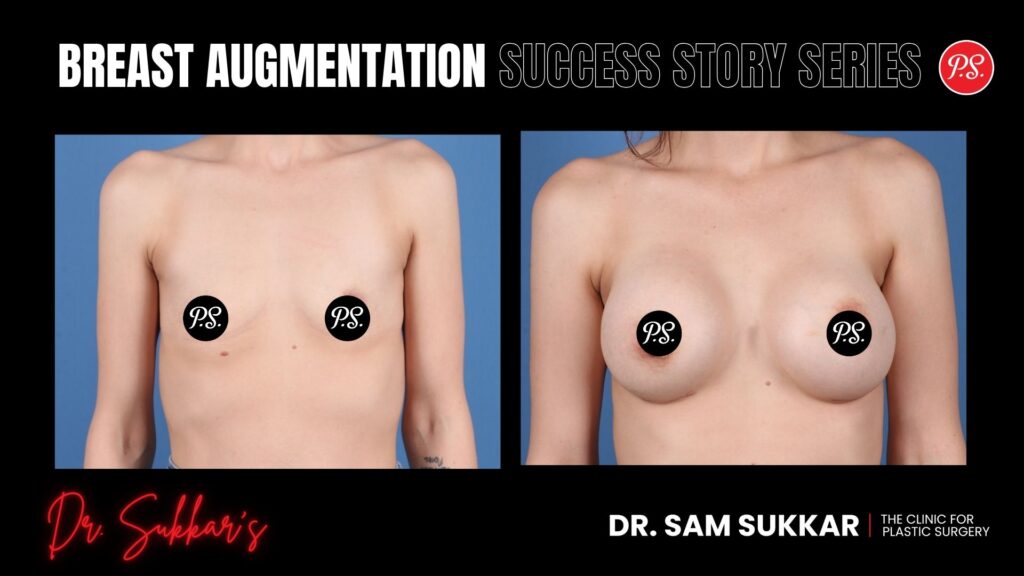
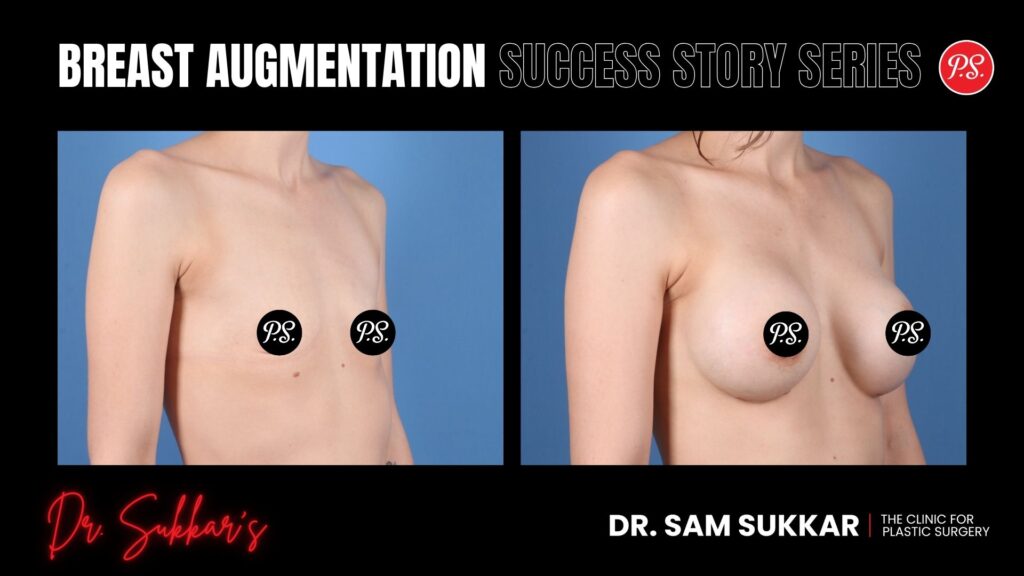
Breast Augmentation at 30: Houston Patient’s Journey to Confidence

Breast Augmentation Success Story Series by Dr. Sam Sukkar, MD in Houston, TX | Case Study #12


This is part of our series featuring real patient transformations at The Clinic for Plastic Surgery. Each case study provides an in-depth look at actual procedures, recovery experiences, and results from Houston patients who’ve undergone breast augmentation with Dr. Sam M. Sukkar.


The mirror doesn’t lie, but sometimes it doesn’t tell the whole truth either. At 30 years old, Jessica* had everything she wanted professionally, a thriving career, close friendships, a partner who adored her, but every time she got dressed, she felt something was missing. Not in her life. In her silhouette.

She’d worn padded bras since high school. Avoided certain necklines. Felt disproportionate in fitted clothes despite her athletic 5’4″ frame. The frustration wasn’t about comparison or conforming to anyone’s standards. It was simpler than that: she wanted her outer appearance to match how she felt inside, confident, feminine, complete.

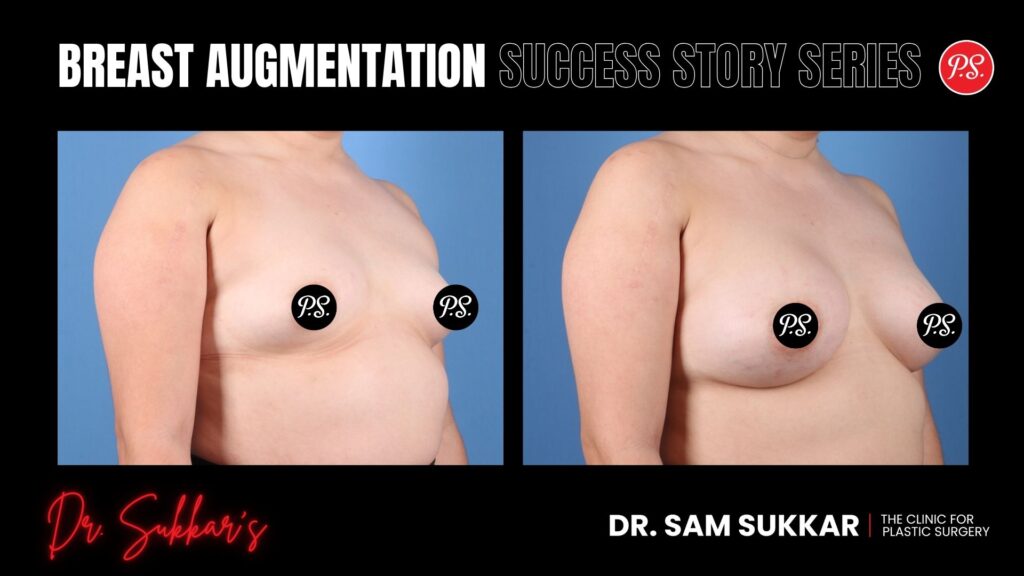
Three months ago, she walked out of surgery with 415cc high-profile silicone implants. Today, she walks into rooms differently.

*The patient’s name was changed to protect their privacy. All medical details and photographic before and after results are from actual Patient Case #12. Individual results may vary based on body type, surgical approach, and adherence to post-operative instructions.

What Brought Jessica* to The Clinic for Plastic Surgery

Years of Dissatisfaction With Breast Size

Jessica* came to our Houston office with a clear vision but reasonable expectations. At 118 pounds and 5’4″, her petite frame carried a 32B cup size that had remained unchanged since her early twenties. While some women feel perfectly content at this size, Jessica* experienced persistent frustration with how clothes fit and how she appeared in photos.

Her concerns centered on three specific issues: lack of upper pole fullness, minimal cleavage even in supportive bras, and proportional imbalance with her athletic lower body from regular exercise. She’d researched breast augmentation options in Houston extensively and arrived at our consultation with photos of results she admired, all natural-looking enhancements that maintained proportion rather than dramatic size increases.

Breast Augmentation at 30: Houston Patient’s Journey to Confidence - Breast Augmentation Success Story Series in Houston, Texas by Dr. Sam Sukkar, MD

Addressing Common Fears About Breast Augmentation

During our initial meeting, Jessica* voiced concerns I hear frequently from first-time surgical patients. Would the results look obvious or artificial? How long would recovery truly take, the internet offered wildly different timelines. Could she return to her fitness routine without compromising results?

Concern about scarring: She worried visible incisions would be a permanent trade-off for fuller breasts.

Concern about implant feel: Jessica* had heard stories about implants feeling hard or unnatural, particularly with silicone options.

Another concern was sizing: Choosing the right volume felt overwhelming. Too small might mean disappointment; too large could mean looking disproportionate or requiring future downsizing.

I addressed each concern directly. Inframammary incisions, hidden in the natural breast fold, heal remarkably well on younger patients with good skin quality. Modern silicone implants, particularly the cohesive gel formulations we use, provide a natural feel that’s indistinguishable from breast tissue in most cases. As for sizing, we’d use dimensional planning based on her chest measurements, existing breast tissue, and aesthetic goals to identify the optimal volume range before surgery.

Tailoring Breast Augmentation to Jessica’s* Petite Frame

The Surgical Approach

Jessica’s* procedure combined several strategic decisions designed specifically for her body type and desired outcome:

1. Bilateral Augmentation Mammoplasty (Breast Augmentation Surgery)

  • Mentor silicone implants with high-profile extra projection (HP Xtra)
  • 415cc volume for both right and left breasts
  • Subpectoral (submuscular) placement for natural upper pole transition

2. Subpectoral Implant Placement

  • Positioned implants beneath the pectoralis major muscle
  • Provided additional soft tissue coverage over implants
  • Reduced risk of visible rippling and created smoother contour

3. Inframammary Incision Approach

  • Precise pocket creation through breast fold incision
  • Direct visualization for accurate implant positioning
  • Scar placement in natural shadow of breast crease

The combination of high-profile silicone implants with submuscular placement created the projection Jessica* wanted while maintaining a natural appearance. The 415cc volume represented the ideal balance, significant enough to achieve her goals without overwhelming her 5’4″, 118-pound frame.

Why This Specific Surgical Strategy Worked

Jessica’s* narrow chest width and limited existing breast tissue meant we needed an implant profile that provided forward projection rather than excessive width. Standard moderate-profile implants would have extended too far laterally on her frame, creating an unnatural appearance.

The Mentor HP Xtra silicone implants solved this challenge perfectly. These implants concentrate volume in a narrower base diameter, projecting forward to create the fullness and cleavage Jessica* wanted without extending beyond her natural chest boundaries. Combined with subpectoral placement, the muscle provided additional coverage that softened the upper pole transition, critical for avoiding the obvious “implant look” she wanted to avoid.

Having performed over 20,000 procedures throughout my career, I’ve learned that successful breast augmentation isn’t about achieving a specific cup size, it’s about creating harmony between implant dimensions and individual anatomy. Jessica’s* chest measurements, breast base width, and existing tissue thickness all factored into selecting 415cc as the optimal volume. Larger would have risked bottoming out or visible rippling; smaller wouldn’t have achieved the fullness she desired.

The surgical approach also accounted for her active lifestyle. Submuscular placement provides long-term stability that holds up well for patients who exercise regularly, which Jessica* planned to resume after full recovery.

Jessica’s* Healing Process After Breast Augmentation

The First Two Weeks: Managing Discomfort and Restrictions

Days 1-3 brought the predictable challenges of submuscular augmentation. Jessica* experienced significant chest tightness, a sensation she described as “wearing a too-tight sports bra while someone sits on your chest.” Not excruciating, but constantly present. Pain medication managed the discomfort effectively, though she felt drowsy and spent most of these first days resting upright in a recliner.

Swelling was substantial. Her breasts sat high and firm, positioned almost at her collarbone, a normal post-operative appearance that concerned her until I explained the “drop and fluff” process. Over the coming weeks, gravity and tissue relaxation would allow the implants to settle into their final position.

During Week 1, Jessica* followed our post-operative protocol precisely:

No lifting anything over 5 pounds (including grocery bags, laundry, or pets)
Wearing the surgical support bra 24/7 (except during approved showers)
Sleeping elevated at 30-45 degrees to minimize swelling
No upper body exercise or stretching that engaged the chest muscles

By Week 2, the sharp discomfort had transitioned to a dull ache. Jessica* returned to our office for her first post-operative appointment, where we confirmed proper healing and early implant positioning. She was cleared to drive short distances and resume light daily activities, though chest-intensive tasks remained off-limits.

Weeks 3-8: Watching the Transformation Unfold

Weeks 3-4 marked a turning point. The oppressive tightness finally eased, replaced by occasional twinges when she moved certain ways. Jessica* described it as “remembering the implants are there” rather than constant awareness. She resumed working from her home office full-time and began wearing normal (non-underwire) bras.

The visual changes during this phase were remarkable. Her implants began their descent, settling lower on her chest wall and developing more natural upper pole slopes. The initially prominent fullness near her collarbone softened as the lower breast filled out. She could finally see the shape emerging, not the final result yet, but clearly heading in the right direction.

Weeks 5-8 brought gradual refinement. Residual swelling continued diminishing, revealing increasingly natural contours. Jessica* was cleared to resume light cardio at Week 6 and progressive upper body strengthening at Week 8, starting conservatively and increasing gradually.

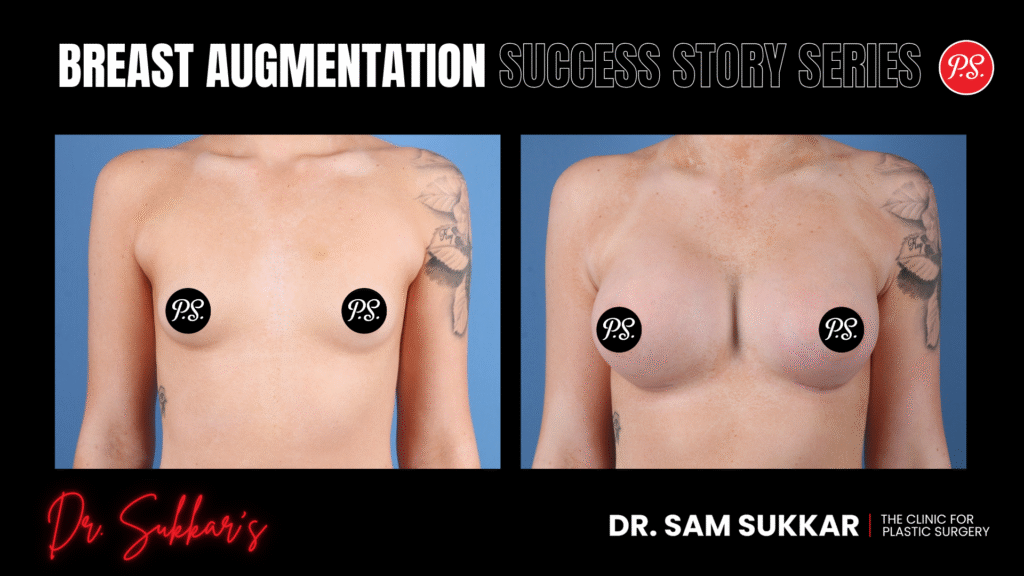
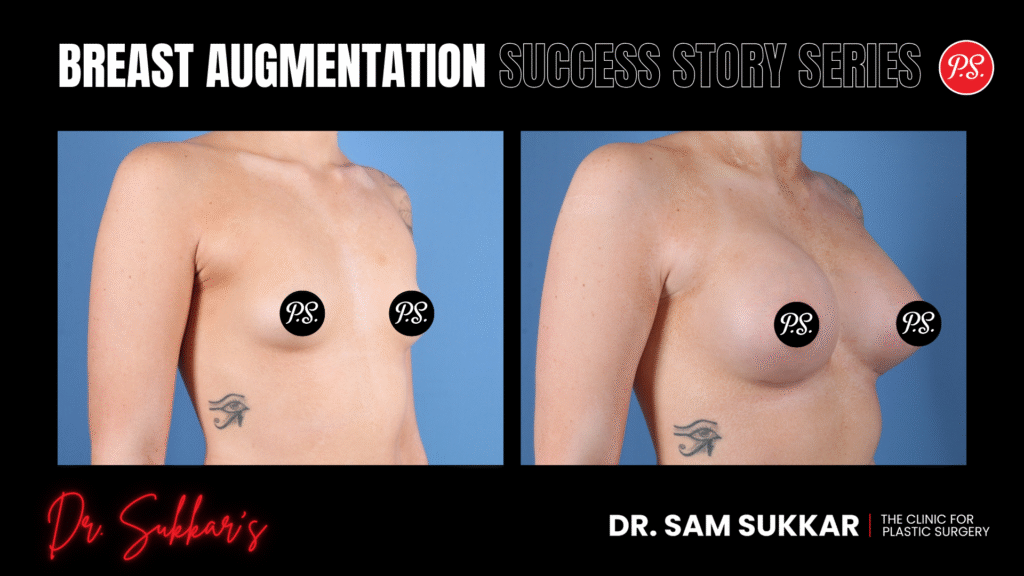
By three months post-operative, the timeframe captured in her before and after photos, Jessica’s* results had largely stabilized. The implants had settled into their final position, soft tissue had draped naturally, and the incision lines had faded to thin pink lines that would continue lightening over the coming year.

Breast Augmentation at 30: Houston Patient’s Journey to Confidence - Breast Augmentation Success Story Series in Houston, TX by Dr. Sam Sukkar, MD

Remarkable Results at Three Months Post-Operative

Jessica’s* transformation centered on measurable changes that addressed her original concerns:

She progressed from a 32B cup size to a full C or small D (depending on bra manufacturer), achieving the proportional balance she’d sought. The 415cc Mentor HP Xtra implants created significant upper pole fullness, the area that had previously appeared deflated, while maintaining a natural teardrop silhouette. Her narrow chest width, which had been a planning consideration, now showcased the implants beautifully without lateral displacement or unnatural width.

The submuscular placement delivered the soft, natural feel she’d hoped for. The implants moved naturally with her body and felt indistinguishable from her own tissue in most positions. Scarring remained minimal, with the inframammary incisions barely visible in the natural breast crease.

Jessica* experienced exactly what she’d come to our Houston office hoping to achieve: breasts that looked like they’d always been hers, just the version she’d always wanted. She wore fitted clothing with new confidence, appreciated her silhouette in photos, and no longer felt the need for padded bras or strategic dressing to create the illusion of fullness.

The Technical Elements That Produced This Outcome

Several factors converged to create Jessica’s* successful result:

Precise implant selection matched to her chest dimensions, the 415cc volume and high-profile configuration provided adequate projection without excessive width for her narrow torso.

Submuscular placement created the soft upper pole transition that avoided the obvious implant appearance, particularly critical for petite patients with minimal existing breast tissue.

Meticulous surgical technique during pocket creation ensured symmetrical positioning and proper implant depth, small variations in pocket dimensions can create noticeable asymmetry, especially with high-profile implants.

Patient compliance during recovery, Jessica* followed every restriction and guideline, allowing optimal healing without complications that could have compromised the result.

Realistic expectations aligned with achievable outcomes, Jessica* came to surgery understanding what breast augmentation could and couldn’t accomplish, which translated to genuine satisfaction rather than disappointment over unmet expectations.

These elements don’t work in isolation. Even perfectly selected implants can produce suboptimal results if placed imprecisely or if patients resume restricted activities too early. Conversely, flawless surgical technique can’t overcome implant choices mismatched to a patient’s anatomy. Success requires alignment across all variables.

Common Questions About Breast Augmentation Like Jessica’s* in Houston

Why Choose High-Profile Implants for a Petite Frame?

For patients with narrow chest widths like Jessica*, high-profile implants concentrate volume in a smaller base diameter, projecting forward rather than extending laterally. This creates natural-looking fullness without breasts that appear too wide for the frame. Moderate-profile implants in the same volume would have extended beyond Jessica’s* natural breast boundaries, creating an obviously augmented appearance. The HP Xtra profile specifically provided the forward projection she wanted while respecting her chest dimensions.

How Long Until Breast Augmentation Results Look Natural?

The “drop and fluff” process varies by individual, but most patients see significant settling within 6-8 weeks. Complete results typically stabilize around 3-6 months post-operatively as residual swelling fully resolves and tissues adapt to the implants. Submuscular placement generally involves a longer settling period than subglandular placement because the muscle must relax to allow proper implant descent. Patients should expect their breasts to sit high and firm initially, this is normal and temporary. The healing timeline Jessica* experienced represents a typical submuscular augmentation recovery.

Can You Exercise Normally After Breast Augmentation?

Yes, but resumption must be gradual and strategic. Lower body cardio can typically resume around Week 3-4, while upper body exercises involving the chest muscles usually wait until Week 6-8 minimum. High-impact activities (running, jumping) require adequate healing time to prevent implant displacement or complications. Most patients return to full unrestricted exercise by 10-12 weeks post-operatively. Jessica’s* active lifestyle factored into our surgical planning, submuscular placement provides long-term stability for patients who exercise regularly, though healing still requires initial restrictions to allow proper tissue integration.

Ready to Write Your Own Breast Augmentation Success Story in Houston, TX?

Jessica* walked into my Houston office feeling disproportionate and frustrated with her silhouette. She walked out three months later with natural-looking C-cup breasts that finally matched how she felt inside, confident, proportionate, complete.

Your story might be different. Maybe you’re concerned about choosing the right implant size, wondering about recovery with your busy schedule, or trying to understand which surgical approach fits your body type.

But the common thread is this: You deserve to feel confident and comfortable in your own body. The breasts you’ve always wanted are within reach with the right surgical approach tailored to your unique anatomy. If dissatisfaction with your breast size is affecting your quality of life, transformation is possible.

Schedule Your Personalized Consultation here, or call us today at (281) 940-1535 and learn how we can create your customized surgical plan!

Your Premier Destination for Plastic Surgery in Houston, Texas (TX)

Are you located in one of these Houston Metro Area cities?

Houston, The Woodlands, Sugar Land, Katy, Pearland, Pasadena, League City, Baytown, Conroe, Cypress, Spring, Kingwood, Humble, Missouri City, Friendswood, Bellaire, Clear Lake, Tomball, Galveston, Richmond, Rosenberg, Stafford, La Porte, Deer Park, Seabrook, Webster, Alvin, and Channelview.

Board-Certified Plastic Surgeon Dr. Sam Sukkar, MD, FACS, and The Clinic for Plastic Surgery Team are here to help you achieve refined, natural-looking results.

Offering expert cosmetic enhancements in:

  • Breast Augmentation, Breast Lifts, and Breast Reduction
  • Tummy Tucks, Mommy Makeovers, and Liposuction
  • Facelifts, Neck Lifts, and Rhinoplasty
  • Body Contouring and Skin Tightening Procedures
  • Non-Surgical Aesthetic Treatments

Visit our modern 18,000+ sq.ft. luxurious plastic surgery center and med spa in Houston, Texas, where expertise meets artistry. Our highly skilled and compassionate team ensures a seamless experience, from consultation to recovery.

For patients outside of the Houston area or those with a busy schedule, Schedule a Virtual Consultation.

Schedule your personalized consultation today at DrSukkar.com or call (281) 940-1535.

About the Author – Meet Dr. Sam Sukkar, MD
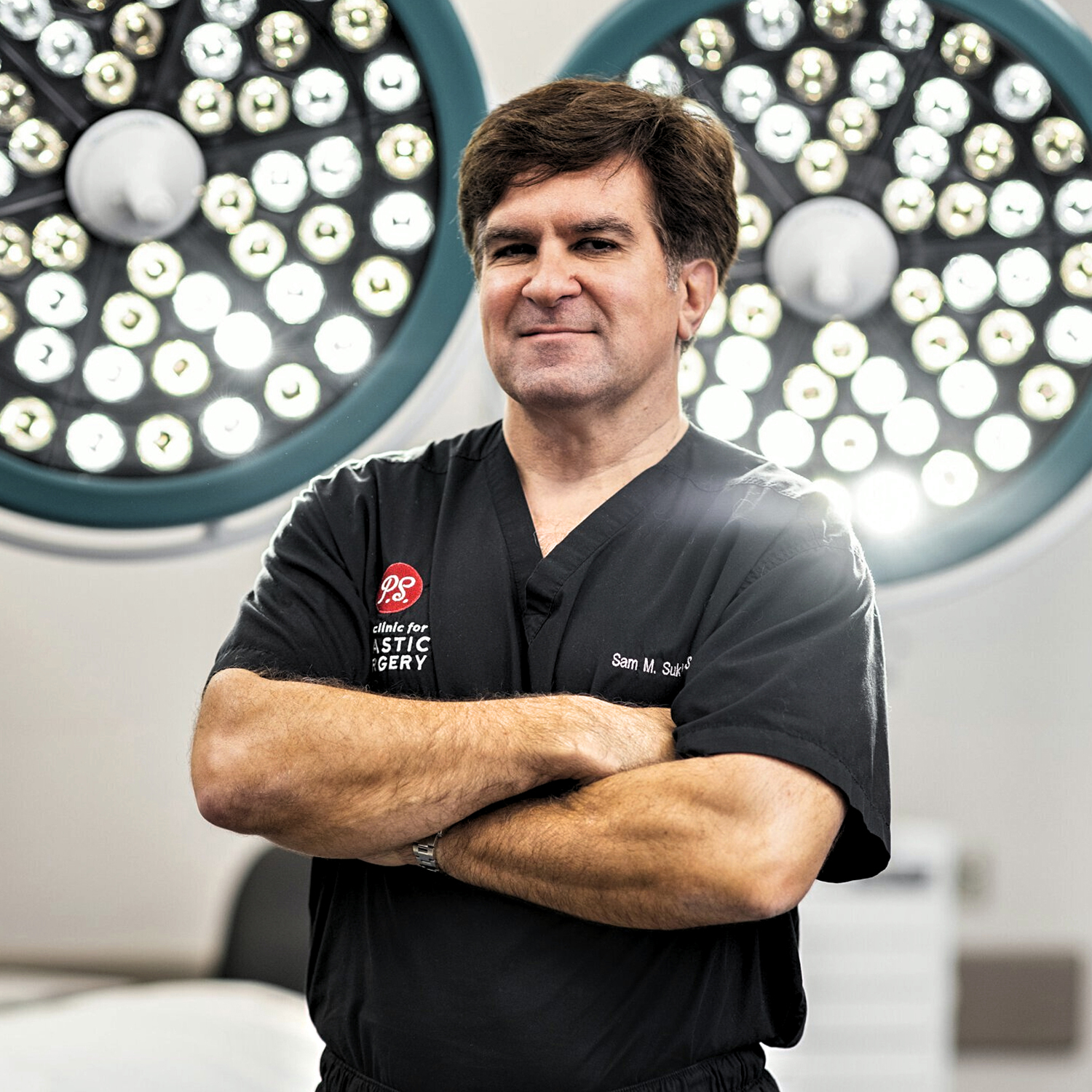
Dr. Sam Sukkar, MD, FACS is a highly respected Board-Certified Plastic Surgeon in Houston, Texas, known for his expertise in advanced cosmetic and reconstructive procedures. As the founder of The Clinic for Plastic Surgery, Dr. Sukkar has set a new standard for excellence, performing over 20,000 procedures with a focus on delivering natural, refined results.

Dr. Sukkar earned his Doctor of Medicine (M.D.) degree from Louisiana State University School of Medicine in 1992 after graduating summa cum laude with a Bachelor of Science in Microbiology. He then completed an intensive General Surgery Residency at the University of Texas Hermann Hospital before being selected for a highly competitive Plastic Surgery Fellowship at Northwestern University in Chicago, one of the most prestigious training programs in the country.

With more than 20 years of experience, Dr. Sukkar is a Diplomate of the American Board of Plastic Surgery and a Fellow of the American College of Surgeons (FACS). He is also an active member of the American Society of Plastic Surgeons (ASPS) and the Houston Society of Plastic Surgery (HSPS). His dedication to innovation and continuing education has solidified his reputation as a leading expert in aesthetic surgery, specializing in breast surgery, body contouring, facial procedures, and non-invasive treatments.

Dr. Sukkar’s expertise has been recognized by Houston Magazine, naming him one of Houston’s “Top Docs for Women,” and he has been featured among RealSelf’s America’s Top Doctors. Committed to his patients, he prioritizes personalized care, ensuring every individual feels informed, comfortable, and confident in their aesthetic journey.

Contact Dr. Sukkar today to schedule a consultation, visit DrSukkar.com to learn more, or call us directly at (281) 940-1535.

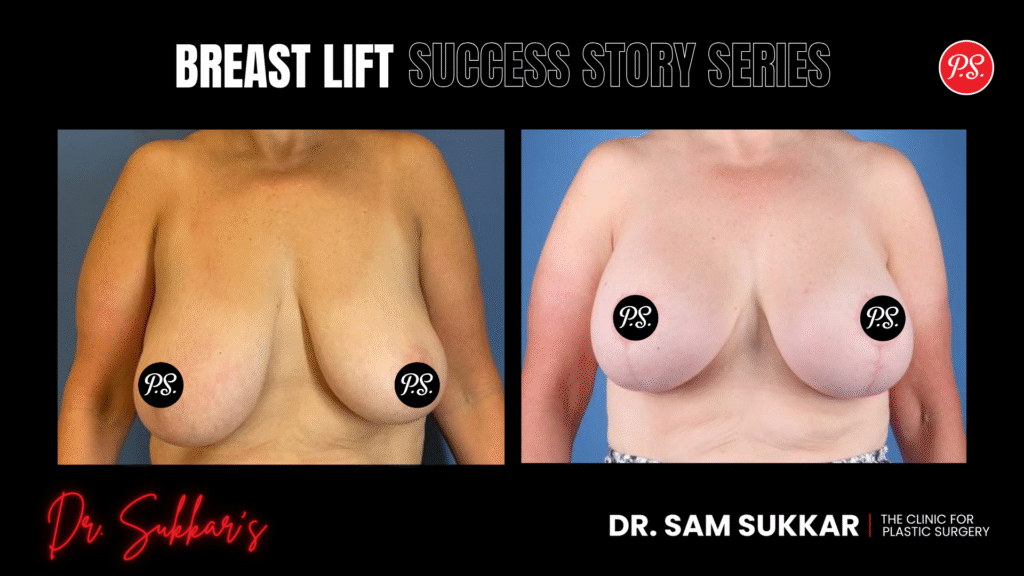
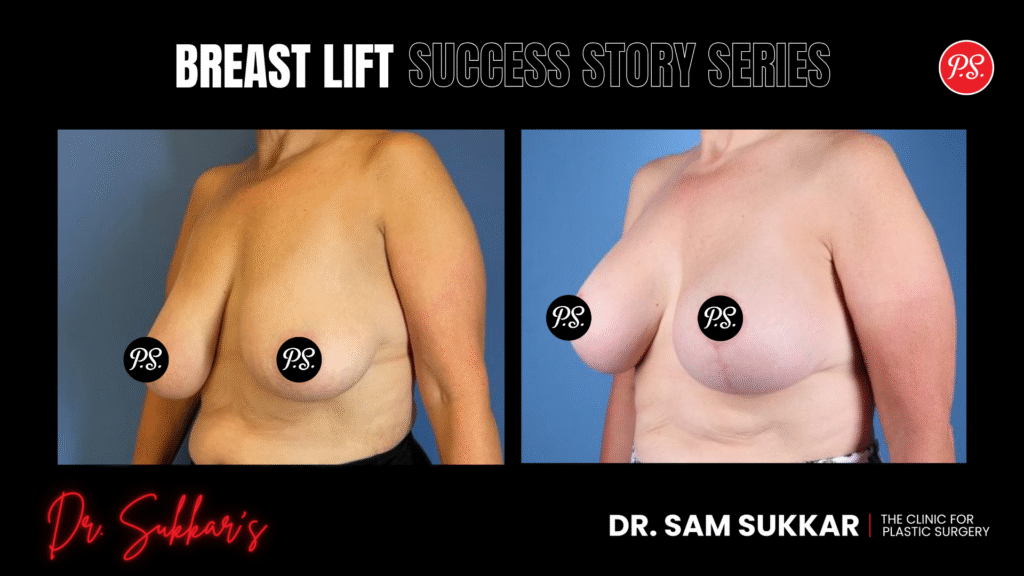
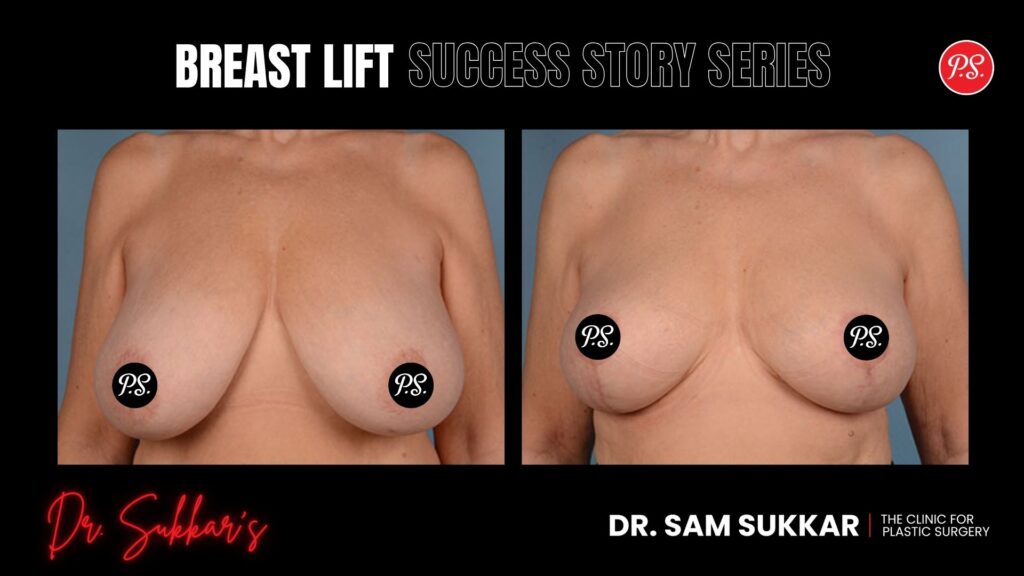
Breast Lift at 48: Houston Mom’s DD-to-Lifted Success

Breast Lift Success Story Series by Dr. Sam Sukkar, MD | Case Study #6513


This is part of our series featuring real patient transformations at The Clinic for Plastic Surgery. Each case study provides an in-depth look at actual procedures, recovery experiences, and results from Houston patients who’ve undergone breast lift surgery with Dr. Sam M. Sukkar.
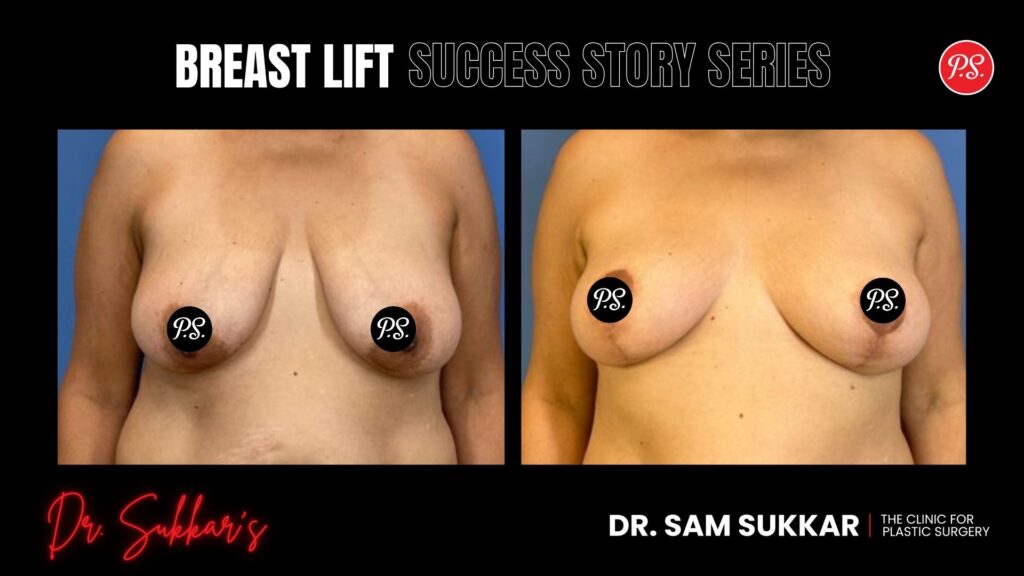

At 48, Rebecca* had made peace with her body in ways many women never do. She loved her DD cup size. She appreciated the curves that had fed two children and carried her through nearly five decades of life. But when she looked in the mirror, gravity told a different story than the one she felt inside.

“I don’t want smaller breasts,” she told me during our first consultation, her hands gesturing to emphasize the point. “I just want them back where they used to be.”

Rebecca* stood 5’1″ with a petite frame that made her naturally full breasts even more pronounced. At 138 pounds, she was healthy and active, but years of natural volume combined with breastfeeding had created significant descent. She wasn’t seeking transformation, she was seeking restoration.

*The patient’s name was changed to protect their privacy. All medical details and photographic before and after results are from actual Patient Case #6513. Individual results may vary based on body type, surgical approach, and adherence to post-operative instructions.

What Brought Rebecca* to My Houston Practice

The Decision Behind the Lift

Rebecca* wasn’t dealing with dramatic sagging or asymmetry that interfered with clothing or caused discomfort. Her concerns were more subtle but equally valid. She noticed her breasts had lost their upper pole fullness, that rounded contour across the top of the breast that signals youthful position. Her nipples pointed downward instead of forward. When she wore a supportive bra, everything looked fantastic. Without one, she felt self-conscious.

“I’m not trying to look 25 again,” she explained. “I just want to look like myself at my best.”

This clarity made her an ideal candidate for breast lift surgery. She understood the realistic outcomes, had appropriate expectations, and most importantly, she knew exactly what she didn’t want to change. Her size was perfect for her frame and personal preference. We weren’t adding or removing volume. We were repositioning what nature had given her.

Addressing Pre-Surgery Questions

Rebecca* came to our consultation prepared with specific questions that many women considering a breast lift in Houston ask:

Would she lose sensation? Temporary changes in nipple sensitivity are common during healing, but permanent loss is rare when the procedure is performed with meticulous technique. I explained how we preserve nerve pathways throughout the lift.

How noticeable would the scars be? Breast lift scars are inevitable, this isn’t a procedure we can perform without incisions. However, scar placement follows the natural contours of the breast, and proper wound care combined with genetic factors typically results in well-healed, fade-over-time incision lines.

Could she maintain her current cup size? Absolutely. A mastopexy reshapes and lifts existing tissue without removing significant volume. Some minor reduction in measurement can occur due to tissue tightening, but she would remain comfortably within the DD range she loved.

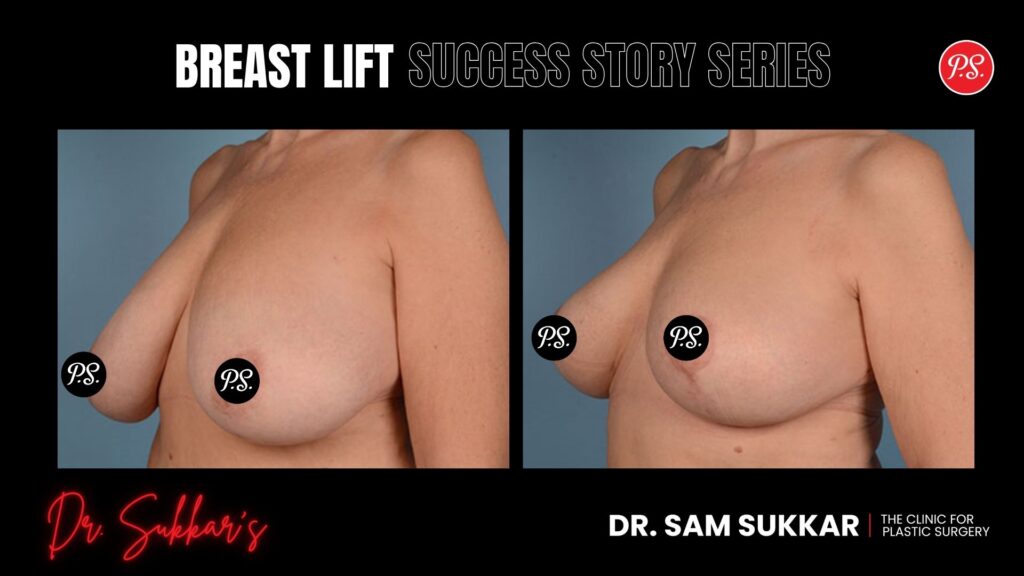
Breast Lift at 48: Houston Mom's DD-to-Lifted Success - Breast Lift Success Story Series in Houston, Texas by Dr. Sam Sukkar, MD

Crafting Rebecca’s* Bilateral Mastopexy Approach

Rebecca* required a bilateral mastopexy, commonly known as a breast lift, using a technique tailored to her degree of ptosis (sagging) and breast density.

1. Vertical Mastopexy with Limited Horizontal Component

  • Incisions placed around the areola, vertically down to the breast crease, and a small horizontal component along the fold
  • This “lollipop plus short horizontal” pattern provided sufficient access to reposition tissue while minimizing scarring compared to a full anchor incision
  • Allowed for precise nipple-areola complex repositioning to a more anterior, youthful projection

2. Internal Tissue Reshaping

  • Removal of excess skin from the lower pole while preserving underlying glandular tissue
  • Creation of an internal “bra” by suturing deeper breast tissue into a more elevated position
  • This technique provides long-term support beyond what skin tightening alone could achieve

3. Nipple-Areola Complex Repositioning

  • Elevation to an ideal position that balanced proportion with Rebecca’s* petite 5’1″ frame
  • Preservation of nipple sensation through careful nerve pathway mapping
  • Areola sizing maintained at her natural diameter since no reduction was needed

The bilateral breast lift procedure took approximately two and a half hours. Rebecca* received general anesthesia and was monitored throughout by our experienced anesthesia team. The approach prioritized natural-looking results that would age gracefully rather than an overly “operated” appearance.

Why This Approach Made Sense

Many patients Rebecca’s* age assume they need implants to achieve lifted, youthful breasts. In reality, women with naturally full breasts often achieve their best outcomes through breast lift without implants. Adding volume she didn’t need would have created an overly augmented look inconsistent with her goals.

Her petite height was another consideration. On a 5’1″ frame, DD breasts already command significant visual presence. Maintaining this size while improving position created balanced proportions without overwhelming her smaller stature. After more than 25 years of performing these procedures, I’ve learned that respecting a patient’s existing anatomy, rather than imposing a template, consistently produces the most satisfying results.

The decision to use a limited horizontal incision rather than a full anchor pattern reflected Rebecca’s* moderate degree of ptosis. She had enough laxity to warrant more than a simple periareolar lift, but not so much sagging that extensive skin removal was necessary. This middle-ground approach meant shorter scars and faster healing while still achieving the lift she needed.

Rebecca’s* Path Through Breast Lift Recovery

The First Two Weeks: Foundation for Healing

Rebecca* woke from surgery wearing a specialized surgical bra that would become her constant companion for the next several weeks. She described the first 24 hours as uncomfortable but manageable, tightness across her chest, soreness around the incision sites, and difficulty finding comfortable sleeping positions.

The early days required strict adherence to positioning rules. She slept elevated at a 45-degree angle to minimize swelling. Any movement that engaged her chest muscles, reaching overhead, pulling, pushing, was off-limits. Her husband helped with tasks that required arm elevation, and she learned to dress strategically in loose button-front shirts.

Weeks 1-2: Gradual Return to Light Activity

By day four, the acute discomfort had transitioned to a dull ache. Rebecca* reduced her pain medication from prescription to over-the-counter by the end of the first week. She attended her first post-operative appointment where we removed drains, examined incision healing, and cleared her for short walks, the only cardio approved at this stage.

Weeks 3-6: Seeing the Shape Emerge

Around week three, Rebecca* noticed a significant shift. The tightness eased. The swelling decreased enough that she could see the new breast shape emerging. Most importantly, she felt comfortable enough to return to work, though she still avoided any strenuous activity or heavy lifting.

She transitioned from surgical bras to soft, supportive sports bras without underwire. The incisions had healed enough that she could shower without special precautions, though we maintained careful wound care protocols to optimize scar healing.

Final Restriction Lifting: Weeks 5-6

By week six, Rebecca* received clearance to resume all normal activities, including upper body exercise, lifting, and unrestricted movement. The breast tissue had settled into its final position, nipples pointing forward, upper poles fuller, and overall contour lifted several centimeters higher than pre-surgery.

The shape would continue refining over the following months as residual swelling resolved completely and scars matured, but the dramatic transformation was already evident. When Rebecca* returned for her six-week appointment wearing a fitted top, she smiled wider than I’d seen throughout our entire relationship. “This is exactly what I pictured,” she said simply.

Six-Month Results: The Final Outcome

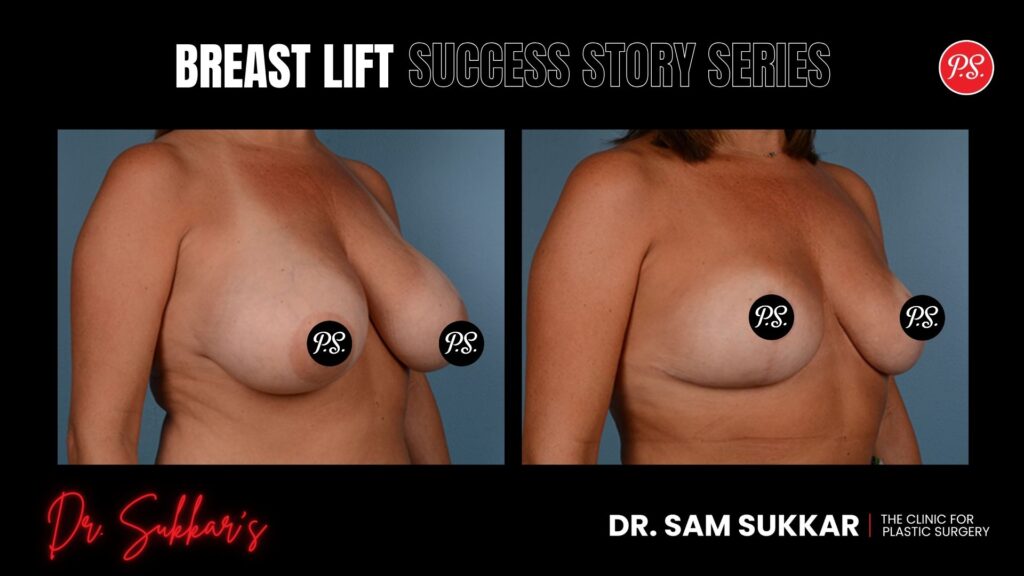
Rebecca* returned for her six-month follow-up appointment with photographs she’d been documenting throughout recovery. The transformation was striking not because of dramatic size change, remember, she maintained her DD volume, but because of the repositioning that restored youthful proportion.

Measurable Changes:

  • Nipple position elevated approximately 4-5 centimeters to an ideal anterior projection
  • Upper pole fullness restored through internal tissue reshaping
  • Breast contour lifted to sit higher on the chest wall
  • Natural teardrop shape maintained with fullness concentrated in the lower breast
  • Incision lines fading to thin, pale lines following the breast’s natural contours

Beyond Physical Measurements

What doesn’t show in measurements is how Rebecca* carried herself. She stood straighter. She wore fitted clothing without the strategic layering she’d relied on before. Rebecca* mentioned looking forward to swimsuit season, something she’d approached with resignation in recent years.

“I finally match how I feel inside,” she told me during that appointment. “I’ve always felt confident, but now my body reflects that confidence.”

What Made This Outcome Particularly Successful

Several factors contributed to Rebecca’s* excellent result:

  1. Realistic expectations aligned with achievable outcomes – She never asked for results that defied anatomical reality. She wanted improvement, not perfection, which set the stage for satisfaction.
  2. Ideal candidate characteristics – Naturally full breasts with good tissue density, healthy body weight, non-smoker, and no significant medical conditions that would impair healing.
  3. Strict adherence to post-operative protocols – Rebecca* followed every restriction, attended every appointment, and performed meticulous wound care. Patient compliance dramatically influences outcomes.
  4. Appropriate technique selection – The vertical mastopexy with limited horizontal component matched her anatomy perfectly, enough intervention to achieve the lift, not so much that we created unnecessary scarring.
  5. Patience through the healing process – Breast lift recovery requires months, not weeks. Rebecca* understood that final results wouldn’t be immediate and trusted the timeline.

For women considering a breast lift versus implants, Rebecca’s* case demonstrates the power of working with existing tissue rather than automatically assuming augmentation is necessary.

Common Questions About Breast Lifts Like Rebecca’s*

Can you lift naturally large breasts like DD cups without implants?

Absolutely. In fact, women with naturally full breasts often achieve superior results through mastopexy alone. The existing tissue provides volume, we’re simply repositioning it to a more youthful location. Adding implants to already full breasts frequently creates an overly augmented appearance and can accelerate future sagging due to increased weight. For patients like Rebecca* with adequate natural volume, breast lift without implants produces beautifully proportioned, long-lasting results.

How long do breast lift results last on a petite frame?

Frame size actually works to your advantage with breast lifts. Smaller, lighter breasts experience less gravitational pull than heavier ones, which can extend the longevity of lift results. That said, factors like pregnancy, significant weight fluctuations, aging, and genetics all influence how long your lifted position lasts. Most patients enjoy their results for 10-15 years, though some degree of gradual settling is natural over time. Rebecca’s* petite 5’1″ frame combined with her stable weight puts her in an excellent position for long-term maintenance of her results.

What’s involved in caring for breast lift scars?

Breast lift scars require consistent attention during the first year for optimal fading. I recommend silicone-based scar treatments starting once incisions are fully healed (typically 2-3 weeks post-op), sun protection to prevent hyperpigmentation, and massage techniques to soften scar tissue. The vertical and limited horizontal incisions Rebecca* received follow natural breast contours and are strategically placed to be concealed by most bras and swimwear. Most patients find their scars fade to thin, pale lines within 12-18 months, continuing to improve for up to two years.

Ready to Write Your Own Breast Lift Success Story?

Rebecca* walked into my Houston office wondering if restoration was possible without changing what she loved about her body. Six months later, she walked through life with the confidence that comes from alignment, when how you look finally matches how you feel.

Your concerns might be different. Maybe you’re wondering whether a lift alone will be enough, questioning if your age makes you a candidate, or trying to understand if the recovery will fit into your life. But the common thread is this: You deserve to feel confident and comfortable in your own body. Your body deserves the same dedication you give to fitness and health. If changes in breast position are affecting your quality of life, transformation is possible.

Schedule Your Personalized Consultation here, or call us today at (281) 940-1535 and discover what’s possible for your unique body and goals in Houston!

Your Premier Destination for Plastic Surgery in Houston, Texas (TX)

Are you located in one of these Houston Metro Area cities?

Houston, The Woodlands, Sugar Land, Katy, Pearland, Pasadena, League City, Baytown, Conroe, Cypress, Spring, Kingwood, Humble, Missouri City, Friendswood, Bellaire, Clear Lake, Tomball, Galveston, Richmond, Rosenberg, Stafford, La Porte, Deer Park, Seabrook, Webster, Alvin, and Channelview.

Board-Certified Plastic Surgeon Dr. Sam Sukkar, MD, FACS, and The Clinic for Plastic Surgery Team are here to help you achieve refined, natural-looking results.

Offering expert cosmetic enhancements in:

  • Breast Augmentation, Breast Lifts, and Breast Reduction
  • Tummy Tucks, Mommy Makeovers, and Liposuction
  • Facelifts, Neck Lifts, and Rhinoplasty
  • Body Contouring and Skin Tightening Procedures
  • Non-Surgical Aesthetic Treatments

Visit our modern 18,000+ sq.ft. luxurious plastic surgery center and med spa in Houston, Texas, where expertise meets artistry. Our highly skilled and compassionate team ensures a seamless experience, from consultation to recovery.

For patients outside of the Houston area or those with a busy schedule, Schedule a Virtual Consultation.

Schedule your personalized consultation today at DrSukkar.com or call (281) 940-1535.

About the Author – Meet Dr. Sam Sukkar, MD

Dr. Sam Sukkar, MD, FACS is a highly respected Board-Certified Plastic Surgeon in Houston, Texas, known for his expertise in advanced cosmetic and reconstructive procedures. As the founder of The Clinic for Plastic Surgery, Dr. Sukkar has set a new standard for excellence, performing over 20,000 procedures with a focus on delivering natural, refined results.

Dr. Sukkar earned his Doctor of Medicine (M.D.) degree from Louisiana State University School of Medicine in 1992 after graduating summa cum laude with a Bachelor of Science in Microbiology. He then completed an intensive General Surgery Residency at the University of Texas Hermann Hospital before being selected for a highly competitive Plastic Surgery Fellowship at Northwestern University in Chicago, one of the most prestigious training programs in the country.

With more than 20 years of experience, Dr. Sukkar is a Diplomate of the American Board of Plastic Surgery and a Fellow of the American College of Surgeons (FACS). He is also an active member of the American Society of Plastic Surgeons (ASPS) and the Houston Society of Plastic Surgery (HSPS). His dedication to innovation and continuing education has solidified his reputation as a leading expert in aesthetic surgery, specializing in breast surgery, body contouring, facial procedures, and non-invasive treatments.

Dr. Sukkar’s expertise has been recognized by Houston Magazine, naming him one of Houston’s “Top Docs for Women,” and he has been featured among RealSelf’s America’s Top Doctors. Committed to his patients, he prioritizes personalized care, ensuring every individual feels informed, comfortable, and confident in their aesthetic journey.

Contact Dr. Sukkar today to schedule a consultation, visit DrSukkar.com to learn more, or call us directly at (281) 940-1535.

Breast Augmentation at 41: Houston Mom’s Confidence Transformation

Breast Augmentation Success Story Series by Dr. Sam Sukkar, MD | Case Study #7778


This is part of our series featuring real patient transformations at The Clinic for Plastic Surgery. Each case study provides an in-depth look at actual procedures, recovery experiences, and results from Houston patients who’ve undergone breast augmentation with Dr. Sam M. Sukkar.


She stood in front of the mirror one Saturday morning, trying on clothes for an upcoming event. Nothing fits quite right. The problem wasn’t her waistline or her legs, it was her chest.

At 41, after years of nursing and natural aging, she felt like her body had lost something she couldn’t get back on her own. The tops that once flattered her now hung awkwardly. She wasn’t asking for attention. She just wanted to feel like herself again.

*The patient’s name was changed to protect their privacy. All medical details and photographic before and after results are from actual Patient Case #7778. Individual results may vary based on body type, surgical approach, and adherence to post-operative instructions.

What Brought Stephanie* to The Clinic for Plastic Surgery

Stephanie’s* Physical Concerns and Personal Goals

Stephanie* came to my Houston office with concerns many women in their forties share. Standing 5’2″ and weighing 126 pounds, she had a petite frame that made volume loss particularly noticeable. Years of breastfeeding had left her breasts smaller and less full than before motherhood. She wasn’t looking for a dramatic transformation, just restoration of what once was, with a proportional enhancement that would make her feel confident in her own skin again.

During our consultation, she expressed specific goals: natural-looking fullness that complemented her petite stature, improved upper pole volume, and results that would look appropriate both in everyday clothing and more fitted outfits. She wanted to avoid an overly augmented appearance while achieving noticeable improvement. For women considering breast augmentation surgery in Houston, finding this balance between enhancement and natural aesthetics is often the primary objective.

Pre-Operative Concerns Stephanie* Shared

Three main concerns emerged during our discussions:

Implant selection and sizing: Stephanie* worried about choosing the right size. Would 350cc be too much for her frame? Too little? She wanted guidance on achieving proportional results that wouldn’t require revision down the line.

Recovery impact on daily life: As an active professional and mother, she needed realistic expectations about downtime. When could she return to work? When could she resume exercise? How would the subpectoral placement affect her recovery timeline?

Natural appearance: Perhaps her biggest concern was avoiding the “obviously augmented” look. She’d seen results that didn’t appeal to her, implants that looked too round, too high, or simply didn’t match the patient’s body type. She wanted results that would make her feel confident, not self-conscious.

Breast Augmentation at 41: Houston Mom's Confidence Transformation - Breast Augmentation Success Story Series in Houston, Texas by Dr. Sam Sukkar, MD

Designing Stephanie’s* Breast Augmentation Strategy

Surgical Approach: Bilateral Augmentation Mammoplasty Details

After comprehensive evaluation of Stephanie’s* anatomy, tissue characteristics, and aesthetic goals, I developed a customized surgical plan:

1. Bilateral Augmentation Mammoplasty (Breast Augmentation Surgery)

  • Inframammary fold (IMF) incision approach for optimal access and minimal visible scarring
  • Subpectoral (submuscular) implant placement for natural upper pole contour and enhanced soft tissue coverage
  • Mentor high-profile silicone implants, 350cc bilaterally, selected for optimal projection relative to her narrow chest width

2. High-Profile Implant Selection

  • Chosen specifically for petite frames requiring maximum projection from minimal base width
  • Silicone fill for natural feel and movement
  • Symmetric 350cc volume bilaterally for balanced enhancement

3. Submuscular Placement

  • Positioned beneath the pectoralis major muscle for natural upper breast contour
  • Enhanced soft tissue coverage for reduced rippling visibility
  • Lower risk of capsular contracture compared to subglandular placement

The types of breast augmentation available require careful matching to patient anatomy. For Stephanie*, the combination of subpectoral placement with high-profile implants offered the ideal balance of natural appearance and noticeable enhancement.

Why This Approach Works for Petite Frames Over 40

Stephanie’s* case required several strategic considerations based on her specific characteristics. At 5’2″ with a narrow chest wall, standard moderate-profile implants would have required larger volumes to achieve her desired projection, volumes that could have looked disproportionate on her frame. High-profile implants solve this equation by providing forward projection from a narrower base diameter.

The subpectoral placement decision reflected multiple factors. First, it provides additional soft tissue coverage, particularly important for petite patients with limited natural breast tissue. This coverage reduces the risk of visible rippling and palpable implant edges. Second, the muscle coverage creates a more gradual, natural-looking upper pole contour rather than the abrupt “shelf” appearance sometimes seen with subglandular placement.

The inframammary fold incision offers distinct advantages I’ve observed over 25 years of practice. It allows direct visualization of the pocket creation, precise control over implant positioning, and results in a scar hidden in the natural breast crease. For patients concerned about breast augmentation recovery, understanding that incision location affects both aesthetic outcomes and healing patterns helps set realistic expectations.

Age considerations also influenced our approach. At 41, Stephanie* had mature breast tissue with some degree of natural elasticity loss. The 350cc volume provided enough fill to smooth existing skin while respecting the limits of her tissue envelope. Overfilling could have created tension-related complications or an unnatural appearance. Conservative, proportional augmentation tends to age better than aggressive sizing, particularly in patients over 40.

Stephanie’s* Breast Augmentation Recovery Experience

The First Two Weeks: Early Healing Phase

The first 72 hours after submuscular breast augmentation are the most intense. Stephanie* experienced typical immediate recovery: significant tightness across her chest, muscle soreness from the subpectoral pocket creation, and swelling that made her results appear higher and firmer than the final outcome would be.

She followed discharge instructions precisely: sleeping elevated at 30-45 degrees, taking prescribed pain medication on schedule, and wearing her surgical support bra continuously. The muscle-related discomfort was more pronounced than the incision site pain, a common pattern with submuscular placement. Movement limitations were real but manageable. She could handle personal care independently but needed help with overhead reaching and heavy lifting.

Weeks 1-2: Gradual Improvement

By day five, Stephanie* noticed marked improvement. The acute muscle soreness began transitioning to tightness. She was able to reduce pain medication and transition to over-the-counter options. Swelling remained significant, and her implants sat notably high on her chest, the expected “riding high” appearance that would resolve as tissues relaxed.

Critical recovery rules she followed:

  • No lifting over 10 pounds for three weeks
  • No pushing, pulling, or reaching overhead
  • Surgical bra worn 24/7 except when showering
  • Walking encouraged; cardio and upper body exercise strictly prohibited
  • Sleeping elevated to minimize swelling

Understanding breast augmentation and lift recovery week by week helps patients anticipate these phases. While Stephanie* had augmentation only (no lift), the recovery principles remain similar regarding tissue healing and activity restrictions.

Weeks 3-8: Transformation Takes Shape

The third week marked a turning point. Muscle tightness had largely resolved, and Stephanie* returned to work with modified duties. She could drive comfortably and resume most daily activities. Her implants had begun their descent, “dropping and fluffing” in common terminology, settling into a more natural position within the breast pocket.

Swelling continued decreasing, allowing her to see her emerging shape more clearly. She remained in her surgical bra but could now wear looser clothing comfortably. Light cardio (walking, easy cycling) was permitted, but upper body resistance training remained off-limits until six-week clearance.

Final Results: Three-Month Post-Operative Assessment

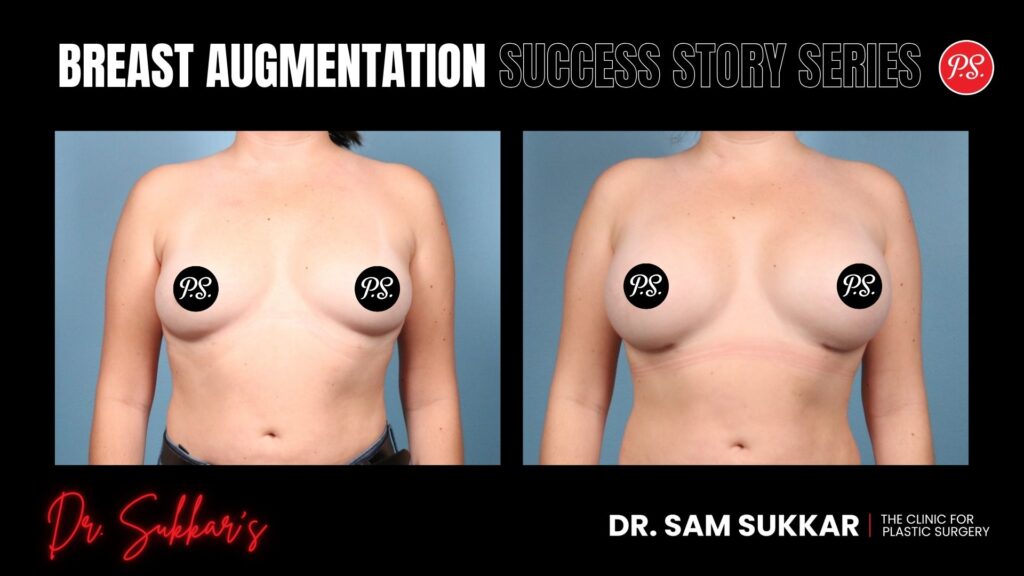
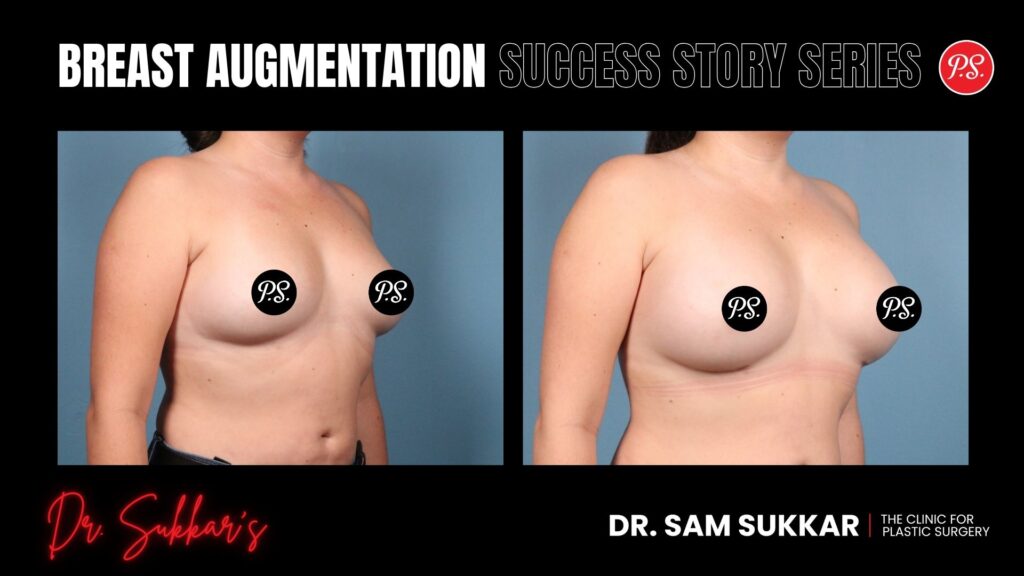
By three months post-surgery, Stephanie* had reached the outcome we’d planned during consultation. Her 350cc Mentor high-profile silicone implants had settled into position, creating natural-looking fullness that complemented her petite 5’2″ frame beautifully. The upper poles showed soft, gradual projection without the artificial “bolt-on” appearance she’d worried about. The inframammary scars had faded to thin, barely perceptible lines hidden in her natural breast creases.

She reported complete comfort in all clothing styles, from fitted workout wear to formal attire. The proportional enhancement allowed her to wear standard bra sizes without specialty shopping. Most importantly, she expressed feeling like herself again, only better.

Remarkable Results: Three Months Post-Operative

The measurable outcomes from Stephanie’s* bilateral augmentation mammoplasty demonstrate the effectiveness of matched surgical planning and patient anatomy:

  • Implant specifications: Mentor high-profile silicone implants, 350cc bilaterally
  • Incision approach: Inframammary fold with excellent scar healing
  • Placement: Subpectoral for natural upper pole contour and soft tissue coverage
  • Projection: High-profile design maximized forward projection on narrow chest wall
  • Symmetry: Balanced bilateral enhancement with even settling and positioning

Beyond these technical specifications, Stephanie* experienced life-changing impact. She reported renewed confidence in clothing choices, comfort in intimate situations, and elimination of the self-consciousness that had developed over years of post-pregnancy volume loss. She no longer avoided fitted clothing or felt the need to compensate with strategic layering.

The psychological transformation accompanied the physical one. Breast augmentation for the right candidate addresses not vanity but restoration, returning patients to how they feel they should look. For detailed visual documentation of similar transformations, reviewing breast augmentation before and after in Houston cases provides realistic expectations.

Breast Augmentation at 41: Houston Mom's Confidence Transformation - Breast Augmentation Success Story Series in Houston, TX by Dr. Sam Sukkar, MD

What Made Stephanie’s* Outcome Exceptional

Several factors contributed to Stephanie’s* outstanding three-month result:

Appropriate implant selection for body type: The high-profile 350cc implants provided ideal projection for her narrow, petite frame without excessive width. This matching of implant geometry to chest wall anatomy is critical, I’ve performed over 20,000 procedures, and proper sizing remains the most important variable in achieving natural-looking results.

Submuscular placement benefits: The subpectoral pocket provided soft tissue coverage that enhanced the natural appearance, particularly in her upper poles. This coverage reduced visibility of implant edges and created gradual contour transitions.

Meticulous surgical technique: Precise pocket creation, careful hemostasis to minimize bleeding and capsule formation, and attention to symmetry during implant positioning all contributed to her smooth recovery and excellent outcome.

Patient compliance with recovery protocols: Stephanie* followed every restriction and recommendation. This adherence to breast augmentation recovery guidelines significantly impacts final results. Patients who resume activity too quickly risk complications that compromise outcomes.

Realistic expectations and clear communication: From initial consultation through post-operative visits, Stephanie* understood what breast augmentation could and couldn’t achieve. This alignment of expectations with surgical capabilities is fundamental to patient satisfaction.

Common Questions About Breast Augmentation for Women Over 40

Why choose high-profile implants for a petite frame like Stephanie’s*?

High-profile implants offer maximum forward projection from a narrower base width, making them ideal for patients with narrow chest walls or those seeking significant projection without excessive lateral breast width. For Stephanie’s* 5’2″ frame, moderate-profile implants would have required larger volumes (potentially 400cc+) to achieve comparable projection, which could have appeared disproportionate. The high-profile geometry delivered her desired fullness while maintaining natural proportions. This implant profile selection becomes increasingly important for women over 40, whose skin elasticity may not accommodate width as readily as younger patients.

How does subpectoral placement affect recovery compared to subglandular placement?

Subpectoral (submuscular) placement involves creating a pocket beneath the pectoralis major muscle, which adds muscle-related discomfort to the initial recovery phase. Patients typically experience 3-5 days of significant chest tightness and movement limitations related to muscle trauma. However, this placement offers substantial long-term advantages: better soft tissue coverage (reducing rippling visibility), more natural upper pole contour, lower capsular contracture rates, and easier mammogram interpretation. For patients prioritizing natural appearance and long-term outcomes over slightly easier initial recovery, submuscular placement is often the superior choice. Understanding these trade-offs helps patients make informed decisions when exploring breast augmentation surgery near me in Houston.

What makes inframammary fold incisions preferable for many patients?

The inframammary fold (IMF) approach places the incision in the natural crease beneath the breast, offering several advantages: direct visualization during pocket creation for precise implant positioning, accommodation of all implant types and sizes, and resulting scars hidden in a natural anatomical boundary. In my experience, IMF incisions heal to thin, barely visible lines in most patients. The location allows easy access for potential future revisions if needed. While periareolar and transaxillary approaches have specific applications, the IMF incision remains my preferred technique for most augmentation cases due to its combination of aesthetic outcomes and surgical versatility.

Ready to Write Your Own Breast Augmentation Success Story?

Stephanie* came to my Houston office uncertain whether breast augmentation was right for her at 41. She left three months later with natural-looking fullness, restored confidence, and renewed comfort in her own body.

Your story might be different. Maybe you’re concerned about choosing the right implant size, wondering about recovery impact on your career and family responsibilities, or trying to understand which surgical approach best suits your anatomy.

But the common thread is this: You deserve to feel confident and comfortable in your own body. The body you want is within reach with the right surgical approach and an experienced surgeon who understands the unique considerations of augmentation for women over 40. If post-pregnancy changes or natural aging are affecting your confidence and quality of life, transformation is possible.

Schedule Your Personalized Consultation here, or call us today at (281) 940-1535 and discover what’s possible for your unique body and goals in Houston!

Your Premier Destination for Plastic Surgery in Houston, Texas (TX)

Are you located in one of these Houston Metro Area cities?

Houston, The Woodlands, Sugar Land, Katy, Pearland, Pasadena, League City, Baytown, Conroe, Cypress, Spring, Kingwood, Humble, Missouri City, Friendswood, Bellaire, Clear Lake, Tomball, Galveston, Richmond, Rosenberg, Stafford, La Porte, Deer Park, Seabrook, Webster, Alvin, and Channelview.

Board-Certified Plastic Surgeon Dr. Sam Sukkar, MD, FACS, and The Clinic for Plastic Surgery Team are here to help you achieve refined, natural-looking results.

Offering expert cosmetic enhancements in:

  • Breast Augmentation, Breast Lifts, and Breast Reduction
  • Tummy Tucks, Mommy Makeovers, and Liposuction
  • Facelifts, Neck Lifts, and Rhinoplasty
  • Body Contouring and Skin Tightening Procedures
  • Non-Surgical Aesthetic Treatments

Visit our modern 18,000+ sq.ft. luxurious plastic surgery center and med spa in Houston, Texas, where expertise meets artistry. Our highly skilled and compassionate team ensures a seamless experience, from consultation to recovery.

For patients outside of the Houston area or those with a busy schedule, Schedule a Virtual Consultation.

Schedule your personalized consultation today at DrSukkar.com or call (281) 940-1535.

About the Author – Meet Dr. Sam Sukkar, MD

Dr. Sam Sukkar, MD, FACS is a highly respected Board-Certified Plastic Surgeon in Houston, Texas, known for his expertise in advanced cosmetic and reconstructive procedures. As the founder of The Clinic for Plastic Surgery, Dr. Sukkar has set a new standard for excellence, performing over 20,000 procedures with a focus on delivering natural, refined results.

Dr. Sukkar earned his Doctor of Medicine (M.D.) degree from Louisiana State University School of Medicine in 1992 after graduating summa cum laude with a Bachelor of Science in Microbiology. He then completed an intensive General Surgery Residency at the University of Texas Hermann Hospital before being selected for a highly competitive Plastic Surgery Fellowship at Northwestern University in Chicago, one of the most prestigious training programs in the country.

With more than 20 years of experience, Dr. Sukkar is a Diplomate of the American Board of Plastic Surgery and a Fellow of the American College of Surgeons (FACS). He is also an active member of the American Society of Plastic Surgeons (ASPS) and the Houston Society of Plastic Surgery (HSPS). His dedication to innovation and continuing education has solidified his reputation as a leading expert in aesthetic surgery, specializing in breast surgery, body contouring, facial procedures, and non-invasive treatments.

Dr. Sukkar’s expertise has been recognized by Houston Magazine, naming him one of Houston’s “Top Docs for Women,” and he has been featured among RealSelf’s America’s Top Doctors. Committed to his patients, he prioritizes personalized care, ensuring every individual feels informed, comfortable, and confident in their aesthetic journey.

Contact Dr. Sukkar today to schedule a consultation, visit DrSukkar.com to learn more, or call us directly at (281) 940-1535.

Breast Lift at 41: Houston Mom’s Natural Rejuvenation

Breast Lift Success Story Series by Dr. Sam Sukkar, MD | Case Study #6510


This is part of our series featuring real patient transformations at The Clinic for Plastic Surgery. Each case study provides an in-depth look at actual procedures, recovery experiences, and results from Houston patients who’ve undergone breast lift surgery with Dr. Sam M. Sukkar.
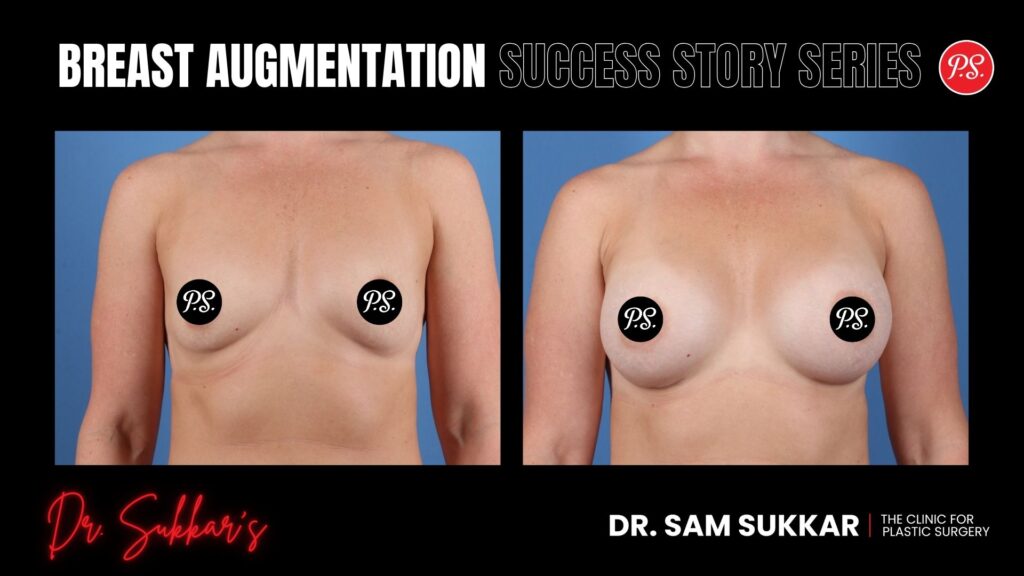

Standing in front of her bedroom mirror one morning, Madison* felt the familiar frustration wash over her. At 41, she loved her D-cup size, the volume was perfect. But gravity had taken its toll. The perkiness she once had, gone. The upper pole fullness disappeared. Madison* didn’t want bigger breasts. She didn’t want implants. She just wanted her breasts back, lifted, reshaped, youthful again.

That realization brought her to my Houston office, and what followed wasn’t about adding volume. It was about restoring what time had taken away.

*The patient’s name was changed to protect their privacy. All medical details and photographic before and after results are from actual Patient Case #6510. Individual results may vary based on body type, surgical approach, and adherence to post-operative instructions.

Madison’s* Path to Breast Rejuvenation

When Volume Isn’t the Problem

Madison came to me with a refreshingly clear goal. At 5’1″ and 156 pounds, she had maintained a healthy, stable weight for years. Her D-cup breasts had the size she wanted, no complaints there. But as she explained during our consultation, “I love the volume. I just hate where it’s sitting.”

She described how her breasts had lost their upper fullness, how her nipples pointed downward instead of forward, how the natural youthful shape had given way to a deflated, elongated appearance. Bras helped, but the moment she took them off, the reality returned. She wasn’t interested in breast augmentation with implants, she wanted natural correction through lifting alone.

Breast Lift at 41: Houston Mom’s Natural Rejuvenation - Breast Lift Success Story Series in Houston, Texas by Dr. Sam Sukkar, MD

What Concerned Madison* Most

Three specific worries emerged as we discussed her goals:

Scarring: Like most women considering a breast lift procedure, Madison’s worried about permanent marks. Would the scars be visible? Would they fade? Could she still wear her favorite tops?

Maintaining Size: She’d heard stories of women losing volume after mastopexy. Since she loved her D-cup, the thought of waking up smaller was terrifying.

Long-Term Results: Would the lift last, or would gravity win again in a few years? She wanted to understand realistic longevity before committing to surgery.

I addressed each concern directly. Modern breast lift techniques create scars that fade significantly over 12-18 months. Volume loss is preventable with proper surgical technique. Existing tissue is repositioned rather than removed. And longevity? With stable weight and proper support, results typically last 10-15 years before natural aging creates noticeable changes again.

Crafting Madison’s* Bilateral Mastopexy Strategy

The Surgical Blueprint

For Madison*, a bilateral mastopexy (breast lift without implants) was the ideal solution. This approach would reshape and elevate her existing breast tissue without adding foreign materials or changing her cup size.

1. Vertical Breast Lift (Lollipop Technique)

  • Incision around the areola and vertically down to the breast crease
  • Ideal for moderate ptosis (sagging) with good existing volume
  • Allows significant lifting while minimizing horizontal scarring
  • Preserves nipple sensation through careful pedicle technique

2. Nipple-Areola Complex Repositioning

  • Elevated nipples to anatomically correct position on breast mound
  • Reduced areola diameter for proportionate, youthful appearance
  • Maintained blood supply and nerve pathways for sensation

3. Internal Breast Reshaping

  • Redistributed existing tissue to create upper pole fullness
  • Tightened breast envelope to eliminate skin laxity
  • Created natural, forward-projecting breast contour

The breast lift approach I selected for Madison’s specifically addressed her ptosis grade while maintaining her desired D-cup volume. The vertical technique would give her the lift she needed without the extended horizontal scars that some mastopexy methods require.

Why This Approach Worked for Madison’s*

In my 25+ years performing breast surgery in Houston, I’ve learned that successful breast lift outcomes depend on matching technique to anatomy. Madison’s case presented several factors that influenced my surgical planning:

Her petite 5’1″ frame meant proportions mattered enormously. Too aggressive with tissue removal, and her breasts would look out of balance. Too conservative with lifting, and the results wouldn’t be dramatic enough. The vertical technique offered the precision I needed.

Her D-cup volume was an asset. Women with good existing breast tissue are ideal candidates for lift-only procedures because we’re working with substantial material. I could create beautiful upper pole fullness by redistributing what she already had rather than relying on implants.

Her realistic expectations made the surgical planning straightforward. She understood that breast lift surgery wouldn’t give her the same look as augmentation, it would give her a natural, elevated version of her own anatomy. That clarity guided every technical decision I made.

Madison’s* Breast Lift Recovery Experience

The First Two Weeks Post-Surgery

Madison described the first 72 hours as uncomfortable but manageable. She experienced tightness across her chest, normal when skin has been tightened and tissue repositioned. Pain medication kept her comfortable, though she noticed the sensation of heaviness despite the surgical bra’s support.

Sleeping propped at 45 degrees felt awkward initially, but by Day 3, she’d adjusted. The drainage tubes (placed to prevent fluid accumulation) were removed at her 48-hour follow-up, providing immediate relief.

Weeks 3-8: Watching the Transformation Unfold

At three weeks post-op, Madison’s transitioned from surgical compression to supportive sports bras. She resumed most daily activities, though still avoided strenuous exercise. The incision sites had healed completely, now the focus shifted to scar management and tissue settling.

She described this phase as “finally seeing the real results emerge.” Swelling had decreased enough that her breast shape looked natural rather than surgically tight. She could wear regular clothing again, though she avoided underwire bras per my instructions.

Final Results Phase: Weeks 5-8

By Week 6, Madison’s was cleared for all normal activities, including exercise. Her breast lift results had settled into their permanent position. The vertical scars, initially pink and visible, had begun fading to light pink lines.

At her 8-week follow-up, she stood before the mirror again, this time with an entirely different emotion. Her D-cup breasts sat high and full on her chest. The upper poles curved naturally. Her nipples projected forward at the anatomically ideal position. Everything she’d wanted, achieved without implants or size change.

Final Breast Lift Results at 3 Months Post-Op

At three months post-surgery, Madison’s transformation demonstrated what breast lift surgery alone can accomplish when surgical technique aligns with patient goals.

Her verified outcomes included:

  • Cup Size Maintained: D-cup volume preserved (as desired)
  • Nipple Position: Elevated 3-4 cm to ideal anatomical placement
  • Upper Pole Fullness: Restored through internal tissue redistribution
  • Breast Projection: Improved forward projection and natural contour
  • Scar Status: Vertical incisions fading to light pink, expected to lighten further

Madison reported complete satisfaction with both the physical results and the decision to pursue mastopexy without augmentation. She could wear everything she wanted, fitted tops, V-necks, swimsuits, without the self-consciousness that had plagued her for years.

Beyond measurements, Madison experienced renewed confidence. She described feeling “like myself again, but the version I was fifteen years ago.” That emotional transformation, the restoration of how she saw herself, represented the true success of her surgery.

Breast Lift at 41: Houston Mom’s Natural Rejuvenation - Breast Lift Success Story Series in Houston, TX by Dr. Sam Sukkar, MD

Why Madison’s* Lift Produced Exceptional Results

Several factors converged to create Madison’s outstanding outcome:

Patient Selection: Her stable weight, good skin elasticity, and realistic expectations made her an ideal breast lift candidate. Not every woman is, I turn away patients whose anatomy or expectations wouldn’t yield satisfactory results.

Technique Precision: The vertical mastopexy technique provided maximum lifting with minimal scarring. Twenty-five years of experience has taught me exactly how much skin to remove, how to reshape internal tissue, and where to position the nipple-areola complex for natural-looking results.

Recovery Compliance: Madison followed every post-operative instruction meticulously. That dedication to proper healing protocols prevented complications and optimized her outcome.

Realistic Timeline: She understood that final results take 3-6 months to fully manifest. Patients who expect immediate perfection often feel disappointed during the healing process. Madison embraced the gradual transformation.

Appropriate Procedure Choice: Her decision to pursue breast lift without implants rather than combination surgery reflected genuine self-awareness about her goals. Too often, patients request augmentation when breast lifting alone would better serve their needs.

Common Questions About Breast Lift Procedures Like Madison’s*

Can a breast lift alone really make a significant difference without implants?

Absolutely, when you have sufficient existing breast tissue like Madison’s did. The breast lift procedure reshapes and elevates what you already have rather than adding volume. For women experiencing ptosis (sagging) but happy with their size, mastopexy alone produces dramatic rejuvenation. I tell patients: if you’re satisfied with how your breasts look in a bra but disappointed without one, lifting is likely your solution rather than augmentation.

Will vertical breast lift scars be visible long-term?

The vertical (lollipop) incision pattern creates breast lift scars around the areola and down to the breast crease. Initially pink and noticeable, these scars typically fade to thin, light lines over 12-18 months. Their final appearance depends on your genetics, skin type, and scar care commitment. Madison’s followed strict silicone sheeting protocols and experienced excellent fading. I position incisions strategically so most clothing, even low-cut tops and bikinis, conceals them completely once healed.

How long do breast lift results typically last?

With stable weight and proper breast support, breast lift results typically last 10-15 years before gravity and natural aging create noticeable changes. Madison’s outcome should remain excellent for over a decade. Future pregnancy, significant weight fluctuation, or substantial weight loss can shorten longevity. That’s why I recommend patients complete childbearing and reach stable weight before undergoing mastopexy.

Ready to Write Your Own Breast Lift Success Story?

Madison came to my Houston office feeling frustrated with gravity’s effects on her otherwise perfect D-cup breasts. Three months later, she left with the youthful, lifted contour she’d been missing, all without implants or size change.

Your concerns might be different. Maybe you’re wondering whether you need breast lift with augmentation or lift alone, concerned about breast lift costs in Houston, or trying to understand which lifting technique suits your anatomy.

But the common thread is this: You deserve to feel confident and comfortable in your own body. The physical changes that come with time, gravity, and life don’t have to be permanent. If sagging breasts are affecting your quality of life, transformation is possible.

Schedule Your Personalized Consultation here, or call us today at (281) 940-1535 and discover what’s possible for your unique body and goals in Houston!

Your Premier Destination for Plastic Surgery in Houston, Texas (TX)

Are you located in one of these Houston Metro Area cities?

Houston, The Woodlands, Sugar Land, Katy, Pearland, Pasadena, League City, Baytown, Conroe, Cypress, Spring, Kingwood, Humble, Missouri City, Friendswood, Bellaire, Clear Lake, Tomball, Galveston, Richmond, Rosenberg, Stafford, La Porte, Deer Park, Seabrook, Webster, Alvin, and Channelview.

Board-Certified Plastic Surgeon Dr. Sam Sukkar, MD, FACS, and The Clinic for Plastic Surgery Team are here to help you achieve refined, natural-looking results.

Offering expert cosmetic enhancements in:

  • Breast Augmentation, Breast Lifts, and Breast Reduction
  • Tummy Tucks, Mommy Makeovers, and Liposuction
  • Facelifts, Neck Lifts, and Rhinoplasty
  • Body Contouring and Skin Tightening Procedures
  • Non-Surgical Aesthetic Treatments

Visit our modern 18,000+ sq.ft. luxurious plastic surgery center and med spa in Houston, Texas, where expertise meets artistry. Our highly skilled and compassionate team ensures a seamless experience, from consultation to recovery.

For patients outside of the Houston area or those with a busy schedule, Schedule a Virtual Consultation.

Schedule your personalized consultation today at DrSukkar.com or call (281) 940-1535.

About the Author – Meet Dr. Sam Sukkar, MD

Dr. Sam Sukkar, MD, FACS is a highly respected Board-Certified Plastic Surgeon in Houston, Texas, known for his expertise in advanced cosmetic and reconstructive procedures. As the founder of The Clinic for Plastic Surgery, Dr. Sukkar has set a new standard for excellence, performing over 20,000 procedures with a focus on delivering natural, refined results.

Dr. Sukkar earned his Doctor of Medicine (M.D.) degree from Louisiana State University School of Medicine in 1992 after graduating summa cum laude with a Bachelor of Science in Microbiology. He then completed an intensive General Surgery Residency at the University of Texas Hermann Hospital before being selected for a highly competitive Plastic Surgery Fellowship at Northwestern University in Chicago, one of the most prestigious training programs in the country.

With more than 20 years of experience, Dr. Sukkar is a Diplomate of the American Board of Plastic Surgery and a Fellow of the American College of Surgeons (FACS). He is also an active member of the American Society of Plastic Surgeons (ASPS) and the Houston Society of Plastic Surgery (HSPS). His dedication to innovation and continuing education has solidified his reputation as a leading expert in aesthetic surgery, specializing in breast surgery, body contouring, facial procedures, and non-invasive treatments.

Dr. Sukkar’s expertise has been recognized by Houston Magazine, naming him one of Houston’s “Top Docs for Women,” and he has been featured among RealSelf’s America’s Top Doctors. Committed to his patients, he prioritizes personalized care, ensuring every individual feels informed, comfortable, and confident in their aesthetic journey.

Contact Dr. Sukkar today to schedule a consultation, visit DrSukkar.com to learn more, or call us directly at (281) 940-1535.

Breast Augmentation at 29: Houston Patient’s Natural Enhancement

Breast Augmentation Success Story Series by Dr. Sam Sukkar, MD | Case Study #10


This is part of our series featuring real patient transformations at The Clinic for Plastic Surgery. Each case study provides an in-depth look at actual procedures, recovery experiences, and results from Houston patients who’ve undergone breast augmentation with Dr. Sam M. Sukkar.
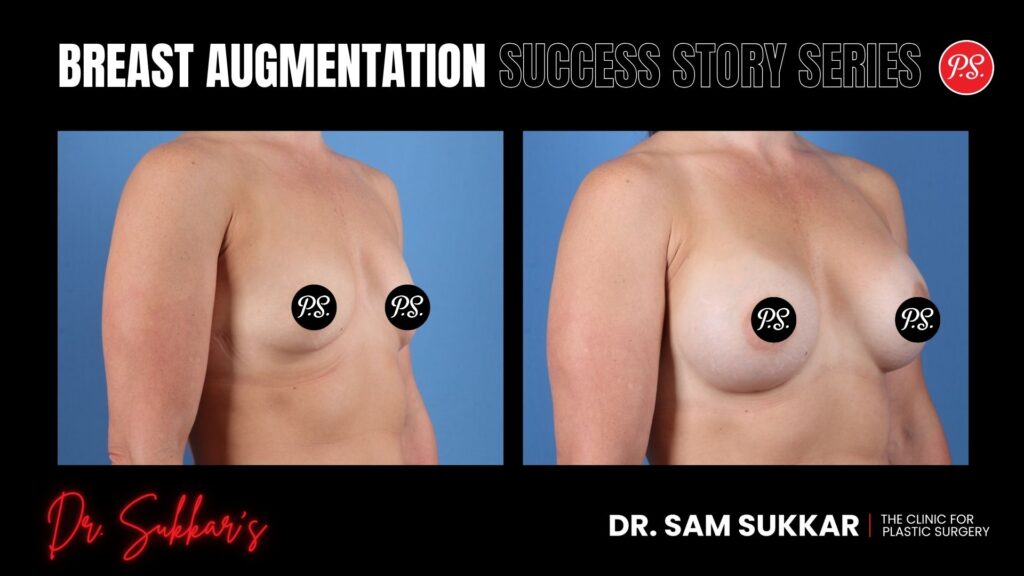

Sofia* scheduled her consultation three weeks after her birthday. At 29, she’d spent years wearing padded bras and layering tops to create curves that simply weren’t there naturally. The moment she walked into my Houston office, I could see the deliberate styling, a structured jacket, a carefully chosen neckline, all designed to add volume where nature had given very little.

She didn’t come in looking for the largest implants possible. She came in with photos on her phone: herself in swimsuits from different angles, screenshots of proportions she admired, and a clear vision of what “enough” looked like. She wanted to fill out her 5’4″ frame without looking obviously augmented. She wanted to shop for clothes that fit both her shoulders and her chest. She wanted to stop adjusting her bra straps hoping for cleavage that would never appear.

*The patient’s name was changed to protect their privacy. All medical details and photographic before and after results are from actual Patient Case #7776. Individual results may vary based on body type, surgical approach, and adherence to post-operative instructions.

Sofia* Path to Breast Enhancement in Houston

What Brought Sofia* to Consider Augmentation

She came to me carrying more than just frustration with her chest. She carried years of compensating. At 173 pounds on a 5’4″ frame, she had curves everywhere except where she wanted them most. Her hips, her thighs, her shoulders all had presence, but her breasts remained disproportionately small no matter how her weight fluctuated.

“I’ve tried everything,” she explained during our first meeting. “Gaining weight just went to my stomach and legs. Losing weight made my chest even smaller. I’m tired of feeling unbalanced.”

She’d been researching breast augmentation surgery in Houston for over two years but kept postponing the decision. The turning point came when she realized she was planning her entire wardrobe around hiding rather than highlighting her figure.

Addressing Pre-Consultation Worries

Sofia* arrived prepared with specific concerns, each one written in her phone’s notes app.

Would the implants look fake? Growing up in Houston’s diverse communities, she’d seen both beautiful results and obvious augmentations. She wanted enhancement that looked like it belonged on her body, proportional, natural, and in harmony with her existing curves.

How would implants feel on someone her size? At 173 pounds, she wasn’t petite, but she also wasn’t plus-sized. She worried about the weight of implants on her chest wall and whether they’d cause back problems or discomfort during daily activities.

Would recovery interfere with her work? As a dental hygienist, she spent hours in positions that required upper body strength and precise movements. Taking too much time off wasn’t financially feasible, yet she couldn’t risk returning too soon and compromising her results.

I’ve spent 25 years addressing these exact concerns with hundreds of Houston patients. The answers aren’t one-size-fits-all, which is precisely why customization matters so much in breast augmentation procedures.

Breast Augmentation at 29: Houston Patient’s Natural Enhancement - Breast Augmentation Success Story Series in Houston, Texas by Dr. Sam Sukkar, MD

Designing Sofia’s* Personalized Augmentation Strategy

The Surgical Approach Selected

Based on Sofia’s* body type, goals, and lifestyle requirements, I designed a focused augmentation strategy:

1. Bilateral Augmentation Mammoplasty (Breast Enlargement Surgery)

  • Inframammary fold (IMF) incision approach for optimal control and minimal visible scarring
  • Subpectoral implant placement beneath the pectoralis muscle for natural upper pole contour
  • Mentor Moderate Plus Profile (MPP) silicone implants, 450cc bilaterally

2. Silicone Gel Implant Technology

  • Cohesive gel formulation for natural feel and movement
  • Moderate Plus Profile specifically chosen for Sofia’s* chest width and projection goals
  • Bilateral symmetry with matched 450cc volumes

The combination of subpectoral placement with moderate plus profile implants would provide Sofia* with the natural-looking fullness she sought while maintaining proportion with her existing body frame. The silicone implant option offers superior tactile characteristics compared to saline, particularly important for patients starting with minimal natural breast tissue.

Why This Combination Made Sense for Sofia*

Sofia’s* body measurements told a specific story. At 5’4″ and 173 pounds with a naturally curvy lower body, she needed sufficient volume to create visual balance. Too small, and the augmentation surgery wouldn’t address the disproportion she’d lived with for years. Too large, and she’d trade one type of imbalance for another.

The 450cc volume in Mentor’s Moderate Plus Profile provided the ideal middle ground. This profile offers more projection than moderate profile implants but maintains a natural slope rather than the dramatic upper pole fullness of high-profile options. For Sofia’s* chest width and existing breast base, this meant her results would enhance without overwhelming her frame.

Subpectoral placement was strongly recommended based on her anatomy and goals. With minimal natural breast tissue providing coverage, placing implants beneath the pectoralis muscle would prevent visible rippling, protect implant longevity, and create the soft, natural upper breast contour she’d shown me in her reference photos. The IMF incision approach would also heal in the natural fold beneath the breast, becoming virtually invisible within months.

I’ve refined this approach across thousands of augmentation procedures in Houston, and the principles remain consistent: match the implant to the patient’s existing anatomy, prioritize natural movement and feel, and plan for results that look like an enhanced version of her rather than a generic augmented appearance. Understanding breast augmentation recovery expectations also shaped our surgical timeline, ensuring Sofia* could return to her physically demanding work safely.

Sofia’s* Healing Process After Breast Augmentation

The First Two Weeks: Managing Discomfort and Protection

Sofia* texted me on Day 2 with a simple message: “This is harder than I thought, but I’m glad I did it.”

The first 72 hours after subpectoral augmentation involve significant muscle tightness. The pectoralis muscle has been partially lifted to create the implant pocket, and that muscle responds with spasm and soreness that feels different from typical muscle pain. Sofia* described it as a combination of extreme tightness and burning across her chest, most noticeable when she tried to lift her arms or stand up straight.

Weeks 1-2: Establishing the New Normal

By Week 2, Sofia* returned for her first post-operative check. The dramatic swelling of the first week had started subsiding, though her breasts still sat higher on her chest than they would ultimately settle. This “riding high” appearance is completely normal as implants need time to descend into their final position, particularly with subpectoral placement.

Critical guidelines Sofia followed:*

  • Wore compression surgical bra 24/7 for the first two weeks to control swelling and support positioning
  • Avoided overhead reaching completely, no reaching into high cabinets, no stretching arms above shoulder height
  • Slept elevated at 30-45 degrees to minimize fluid accumulation
  • No lifting anything heavier than a coffee cup for the full two weeks

Sofia* took 10 days off from her dental hygiene work. By Day 11, she returned to the office for consultation work only, no hands-on patient care yet. Her employer accommodated modified duties for another week, allowing her chest muscles time to heal before resuming the repetitive reaching and pressure her job required. Understanding breast augmentation recovery week by week prepared her for realistic timeline expectations.

Weeks 3-6 and Long-Term Settling

The third week marked Sofia’s* return to full work duties. She described the transition as “awkward but manageable.” The tightness had evolved into occasional pulling sensations, particularly when she reached across patients or maintained extended arm positions during cleanings. She learned to modify her body mechanics slightly, rotating her torso more rather than just extending her arms.

By Week 4, Sofia* sent me photos before her scheduled follow-up. The implants had visibly descended, creating more natural lower pole fullness and reducing the overly full upper breast appearance common in early recovery. She could finally see the shape we’d discussed during consultation beginning to emerge.

Final Results: Months 2-6

At her 6-month post-operative visit, Sofia’s* transformation was complete. The implants had fully settled into their intended position. The initially tight, round appearance had softened into natural-looking breasts that moved naturally with her body. The inframammary fold incisions had faded to thin white lines barely visible even upon close inspection.

Sofia* arrived wearing a fitted dress she’d bought specifically for the appointment, something she never would have chosen before surgery. “I’m not hiding anymore,” she said simply. “These feel like mine now. They look like they belong.”

Six-Month Transformation Results

Sofia’s* breast augmentation delivered exactly the proportional enhancement we’d planned during consultation. At six months post-operative, her 450cc Mentor Moderate Plus Profile silicone implants had settled into a natural position beneath well-healed pectoralis muscle pockets.

The transformation addressed her primary concern of upper and lower body disproportion. Her 5’4″ frame now carried balanced curves from shoulders to hips. The moderate plus profile provided forward projection without excessive upper pole fullness, creating a slope and shape consistent with natural breast tissue. In fitted clothing, her silhouette appeared enhanced rather than obviously augmented.

The subpectoral placement proved its value in her final results. With minimal natural breast tissue coverage, the muscle layer prevented visible implant edges and rippling that can occur with subglandular placement in thin-tissued patients. Sofia* reported the implants felt soft and natural, moving naturally during daily activities and exercise.

From a surgical precision standpoint, the bilateral symmetry remained excellent. Both 450cc implants settled evenly, maintaining matched projection and position. The inframammary fold incisions healed without complications, fading to barely perceptible lines beneath the natural breast fold.

Breast Augmentation at 29: Houston Patient’s Natural Enhancement - Breast Augmentation Success Story Series in Houston, TX by Dr. Sam Sukkar, MD

The Elements That Delivered Sofia’s* Outcome

Accurate volume selection: 450cc provided sufficient enhancement for Sofia’s* 5’4″, 173-pound frame without creating disproportion in the opposite direction. The volume balanced her naturally curvy lower body while maintaining an authentic appearance.

Profile matching to chest anatomy: Moderate Plus Profile suited Sofia’s* chest wall width and desired projection. This profile creates natural forward projection without the aggressive upper pole fullness of high-profile options, critical for the “enhanced but natural” aesthetic she requested.

Subpectoral placement for thin tissue: With limited natural breast tissue, muscle coverage prevented implant visibility and provided superior long-term aesthetic maintenance. This placement choice eliminated the risk of rippling and edge visibility common with subglandular approaches in thin-tissued patients.

Patient compliance during recovery: Sofia* followed post-operative protocols precisely. Her commitment to activity restrictions, compression garment wear, and gradual return to full function allowed optimal healing and implant settling. Reviewing before and after expectations helped her maintain a realistic perspective throughout recovery.

Realistic expectation alignment: From initial consultation forward, Sofia* understood this surgery would enhance her existing frame, not transform her into someone else. This psychological preparation contributed significantly to her satisfaction with results that looked like a naturally fuller version of herself.

Questions Specific to Sofia’s* Breast Augmentation

Why did Dr. Sukkar recommend 450cc implants instead of going larger or smaller?

Volume selection involves precise calculation based on chest wall width, existing breast tissue, and desired projection. For Sofia’s* specific measurements, 5’4″ height, moderate chest width, and minimal starting breast tissue, 450cc in Moderate Plus Profile provided the maximum volume that would still settle naturally and move authentically. Larger volumes would have created excessive projection relative to her shoulder width, risking an obviously augmented appearance. Smaller volumes wouldn’t have achieved the proportional balance she sought with her naturally curvy lower body. I measure chest dimensions during consultation and use these measurements to determine the volume range that will enhance while maintaining natural biomechanics and aesthetic proportion.

Can someone who weighs 173 pounds get breast implants without issues?

Absolutely. Weight itself doesn’t determine augmentation candidacy, body composition, tissue quality, and proportional distribution matter far more. Sofia’s* 173 pounds distributed across a 5’4″ frame with natural curves actually made her an excellent candidate. Her healthy weight provided adequate soft tissue for healing, sufficient chest wall structure to support implants, and realistic enhancement goals. I’ve successfully performed breast augmentation on patients across the full spectrum of healthy body weights. The key is customizing implant selection to each patient’s specific anatomy rather than applying generic size recommendations. Breast augmentation cost considerations remain consistent across patient sizes, as the surgical technique and implant quality don’t vary based on pre-operative weight.

How soon could Sofia return to her physically demanding dental hygiene work?

Sofia* returned to modified duties at 11 days post-operative and resumed full patient care at three weeks. This timeline is typical for subpectoral augmentation in patients with physically demanding occupations. The pectoralis muscle requires approximately 2-3 weeks to heal sufficiently for repetitive reaching and pressure without risking implant malposition or muscle strain. I provided Sofia’s* employer with specific activity restrictions for her first three weeks back, no overhead reaching, no lifting over 10 pounds, no sustained arm extension above shoulder height. By Week 4, she could perform all job duties without restriction. Patients with desk jobs typically return to work within 5-7 days, while those with heavy lifting occupations may need 4-6 weeks before resuming full duties.

Ready to Write Your Own Breast Augmentation Success Story?

Sofia* walked into my Houston office wearing layers designed to create curves that weren’t there. She walked out six months later in fitted dresses she’d never had the confidence to try, curves that now balanced naturally from shoulders to hips.

Your starting point might differ. Maybe you’ve lost volume after breastfeeding, experienced asymmetry you’ve hidden for years, or simply never developed the breast size that matches your frame. Perhaps you’re researching breast augmentation surgeons near you in Houston or exploring payment plan options to make your transformation possible.

But the common thread is this: You deserve to feel confident and comfortable in your own body. The body you want is within reach with the right surgical approach matched precisely to your unique anatomy and goals. If proportion concerns are affecting your clothing choices, your confidence, or your quality of life, transformation is possible.

Schedule Your Personalized Consultation here, or call us today at (281) 940-1535 and discover what’s possible for your unique body and goals in Houston!

Your Premier Destination for Plastic Surgery in Houston, Texas (TX)

Are you located in one of these Houston Metro Area cities?

Houston, The Woodlands, Sugar Land, Katy, Pearland, Pasadena, League City, Baytown, Conroe, Cypress, Spring, Kingwood, Humble, Missouri City, Friendswood, Bellaire, Clear Lake, Tomball, Galveston, Richmond, Rosenberg, Stafford, La Porte, Deer Park, Seabrook, Webster, Alvin, and Channelview.

Board-Certified Plastic Surgeon Dr. Sam Sukkar, MD, FACS, and The Clinic for Plastic Surgery Team are here to help you achieve refined, natural-looking results.

Offering expert cosmetic enhancements in:

  • Breast Augmentation, Breast Lifts, and Breast Reduction
  • Tummy Tucks, Mommy Makeovers, and Liposuction
  • Facelifts, Neck Lifts, and Rhinoplasty
  • Body Contouring and Skin Tightening Procedures
  • Non-Surgical Aesthetic Treatments

Visit our modern 18,000+ sq.ft. luxurious plastic surgery center and med spa in Houston, Texas, where expertise meets artistry. Our highly skilled and compassionate team ensures a seamless experience, from consultation to recovery.

For patients outside of the Houston area or those with a busy schedule, Schedule a Virtual Consultation.

Schedule your personalized consultation today at DrSukkar.com or call (281) 940-1535.

About the Author – Meet Dr. Sam Sukkar, MD

Dr. Sam Sukkar, MD, FACS is a highly respected Board-Certified Plastic Surgeon in Houston, Texas, known for his expertise in advanced cosmetic and reconstructive procedures. As the founder of The Clinic for Plastic Surgery, Dr. Sukkar has set a new standard for excellence, performing over 20,000 procedures with a focus on delivering natural, refined results.

Dr. Sukkar earned his Doctor of Medicine (M.D.) degree from Louisiana State University School of Medicine in 1992 after graduating summa cum laude with a Bachelor of Science in Microbiology. He then completed an intensive General Surgery Residency at the University of Texas Hermann Hospital before being selected for a highly competitive Plastic Surgery Fellowship at Northwestern University in Chicago, one of the most prestigious training programs in the country.

With more than 20 years of experience, Dr. Sukkar is a Diplomate of the American Board of Plastic Surgery and a Fellow of the American College of Surgeons (FACS). He is also an active member of the American Society of Plastic Surgeons (ASPS) and the Houston Society of Plastic Surgery (HSPS). His dedication to innovation and continuing education has solidified his reputation as a leading expert in aesthetic surgery, specializing in breast surgery, body contouring, facial procedures, and non-invasive treatments.

Dr. Sukkar’s expertise has been recognized by Houston Magazine, naming him one of Houston’s “Top Docs for Women,” and he has been featured among RealSelf’s America’s Top Doctors. Committed to his patients, he prioritizes personalized care, ensuring every individual feels informed, comfortable, and confident in their aesthetic journey.

Contact Dr. Sukkar today to schedule a consultation, visit DrSukkar.com to learn more, or call us directly at (281) 940-1535.

Breast Lift Over 40: Houston Mom’s Reduction Journey

Breast Lift Success Story Series by Dr. Sam Sukkar, MD | Case Study #3403


This is part of our series featuring real patient transformations at The Clinic for Plastic Surgery. Each case study provides an in-depth look at actual procedures, recovery experiences, and results from Houston patients who’ve undergone breast lift surgery with Dr. Sam M. Sukkar.


Three months before walking into my Houston office, Rebecca* stood in front of her bedroom mirror feeling disconnected from her reflection. At 44, the woman staring back carried breasts that felt heavy, uncomfortable, and aged beyond her years.

DD cups that once filled her with confidence now brought only back pain and wardrobe frustration. She wasn’t looking to turn back time completely, she simply wanted to feel like herself again.

*The patient’s name was changed to protect their privacy. All medical details and photographic before and after results are from actual Patient Case #3403. Individual results may vary based on body type, surgical approach, and adherence to post-operative instructions.

Breast Lift Over 40: Houston Mom’s Reduction Journey - Breast Lift Success Story Series in Houston, Texas by Dr. Sam Sukkar, MD

Rebecca’s* Path to Breast Reduction in Houston

Physical Discomfort and Aesthetic Goals

Rebecca* came to me after years of managing the physical burden of overly large, drooping breasts. Standing 5’2″ with a starting weight of 148 lbs., her DD cup size created a disproportionate silhouette that affected both her comfort and confidence. The excess breast tissue had begun to sag significantly, creating that aged appearance many women in their 40s struggle to accept.

During our initial consultation, Rebecca* described the daily challenges: chronic upper back and shoulder pain from bra straps digging into her skin, difficulty finding clothes that fit properly, and the emotional toll of watching her breasts lose their youthful position. She wasn’t seeking dramatic transformation, just correction. Her goal was clear: remove the excess tissue, lift what remained to a more youthful position, and achieve a proportionate C cup that matched her petite frame. Breast lift surgery offered the comprehensive solution she needed.

Addressing Pre-Surgical Worries

Rebecca* arrived with questions I hear frequently from women considering breast reduction. Would the scars be visible? How much sensation would she lose? Could the results look natural while still providing the relief she craved?

I reassured her that the vertical incision technique I planned to use, while creating visible scars initially, would fade significantly over time and remain hidden beneath most clothing and swimwear. As for sensation, most patients retain nipple sensitivity when the procedure is performed with careful attention to nerve preservation. The key to natural-looking results lies in proportionate reduction: removing enough tissue to alleviate symptoms while maintaining breast shape that complements her overall frame. After 25+ years of performing these procedures, I’ve learned that honest conversations about realistic expectations create the foundation for satisfied patients.

Customized Breast Reduction Strategy for Rebecca*

The Surgical Approach

Rebecca’s* procedure required a carefully calibrated reduction that would address both the excess tissue and the significant ptosis (drooping) she presented with. Through a vertical incision technique, I performed what’s technically called a reduction mammoplasty, a procedure that simultaneously removes tissue and repositions the breast to a higher, more youthful location.

1. Vertical Incision Breast Reduction

  • Incision pattern extending around the areola and vertically down to the breast crease
  • Removed 300-400 grams of tissue from each breast
  • Repositioned nipple-areola complex to optimal height
  • Reshaped remaining tissue into a more compact, lifted form
  • Reduced cup size from 38DD to 38C

The vertical technique offers distinct advantages for patients like Rebecca*: it provides excellent lifting capability, allows precise tissue removal, and typically results in scars that are less extensive than traditional anchor-pattern incisions. For a petite woman seeking significant reduction, this approach delivers dramatic improvement while maintaining natural breast contour.

The Reasoning Behind This Technique

Breast reduction isn’t simply about removing tissue, it’s about architectural redesign. Rebecca’s* case required removing approximately 300-400 grams from each breast, a substantial amount that would relieve her physical symptoms while bringing her down two cup sizes. But volume reduction alone wouldn’t address the ptosis that aged her appearance.

The vertical incision allowed me to simultaneously lift the breast tissue to a more youthful position on her chest wall. By repositioning the nipple-areola complex upward and inward, I could create the perky, proportionate result she desired. The key surgical decision involved determining exactly how much tissue to remove, enough to alleviate her back pain and create a C cup, but not so much that we’d compromise blood supply or create an unnaturally small appearance on her frame.

At 5’2″ with a medium build, Rebecca* needed breasts that would balance her proportions without overwhelming her petite stature. The 38C outcome I aimed for would distribute weight more evenly across her shoulders and spine while creating a more youthful breast contour. Every incision and every gram removed served the dual purpose of symptom relief and aesthetic enhancement, this integrated approach separates transformative breast surgery from simple tissue excision.

From Surgery to Three-Month Results: Rebecca’s* Recovery

The First Two Weeks Post-Reduction

Rebecca* woke from surgery with her breasts wrapped in surgical dressings and a supportive surgical bra. The first 72 hours brought the expected discomfort, a tight, heavy sensation across her chest combined with moderate pain managed effectively with prescribed medication. Most patients describe this phase as uncomfortable rather than unbearable, and Rebecca* echoed that sentiment.

Swelling peaked during these initial days, making her breasts appear larger than their final size. Bruising developed across the lower breast and occasionally tracked down to the ribcage, a normal response to tissue manipulation. I advised her to sleep elevated at a 45-degree angle, avoid raising her arms above shoulder height, and resist any temptation to peek beneath the dressings.

Week 1-2: Early Healing Phase

By day five, Rebecca* returned for her first dressing change. Seeing her new breast shape for the first time brought tears, the immediate lift was visible even through residual swelling. The vertical incisions appeared red and raised, exactly as expected at this early stage.

During the second week, she transitioned from prescription pain medication to over-the-counter options. Showering became easier once cleared at day seven, though she maintained gentle movements and avoided direct water pressure on the incision sites. The critical recovery rules during this phase:

  • No lifting anything heavier than 10 pounds
  • No reaching overhead or stretching the chest muscles
  • Wearing the surgical bra 24/7 for proper support
  • Sleeping elevated to minimize swelling

Rebecca* followed these guidelines meticulously, understanding that early compliance directly impacts final outcomes. Her diligence during these crucial weeks set the stage for excellent breast lift healing.

Weeks 3-8: Returning to Normal Life

The third week marked a turning point. Rebecca* noticed significantly reduced swelling and could move more comfortably. She returned to desk work at week three and began incorporating gentle walks into her routine. The incisions continued their healing journey, still pink and slightly raised, but no longer requiring daily wound care.

By week four, I cleared her to transition to regular supportive bras (no underwire yet) and gradually increase activity levels. Light stretching felt manageable, though I cautioned against any exercise involving chest muscles for at least another month.

Months 2-3: Final Results Emerge

At the three-month mark when we captured Rebecca’s* after photos, the transformation was complete. Her weight had dropped modestly to 145 lbs., a natural result of removing approximately 600-800 grams of combined breast tissue. More importantly, her breasts now sat at an elevated, youthful position with a natural teardrop shape. The C cup she’d envisioned fit her petite frame perfectly, creating the proportionate silhouette she’d described during our initial consultation.

The vertical incisions had faded from angry red to pale pink, and with continued scar care, I expected them to become nearly imperceptible within the year. Rebecca* reported complete relief from the back and shoulder pain that had plagued her for years. The emotional impact matched the physical: she described feeling lighter, more confident, and finally comfortable in fitted clothing.

Three-Month Outcome: Rebecca’s* Breast Reduction Success

After three months of healing, Rebecca’s* results demonstrated the life-changing potential of properly executed breast reduction surgery:

Physical Changes:

  • Cup size reduced from 38DD to 38C
  • 300-400 grams removed from each breast (approximately 1.5 pounds total tissue excised)
  • Breasts lifted to a more youthful, elevated position on chest wall
  • Significant improvement in ptosis (drooping) eliminated
  • Nipple-areola complex repositioned for optimal aesthetic placement

The numbers tell one story, but Rebecca’s* experience reveals the deeper impact. She no longer experienced the daily shoulder and back pain that had become her constant companion. Finding bras became simple rather than frustrating. Clothes fit properly without requiring size compromises to accommodate her chest. Most significantly, she reported feeling reconnected to her body, the woman in the mirror finally matched the woman she felt like inside.

What Made Rebecca’s* Outcome Exceptional

Several factors contributed to Rebecca’s* excellent three-month result:

Appropriate candidate selection: At 44 with stable weight and realistic expectations, Rebecca* represented the ideal breast reduction patient. Her physical discomfort combined with aesthetic concerns created clear surgical goals.

Precise tissue removal: Removing exactly 300-400 grams per breast achieved her target C cup while maintaining adequate blood supply and nipple sensation. This calibrated approach prevented over-reduction while ensuring symptom relief.

Vertical incision technique: For her degree of ptosis and desired lift, the vertical method provided optimal access and reshaping capability. This technique allowed significant lifting without the horizontal scar component of traditional anchor-pattern incisions.

Meticulous recovery adherence: Rebecca* followed every post-operative instruction precisely. Her commitment to wearing the surgical bra, avoiding premature activity, and attending all follow-up appointments directly influenced her smooth healing process.

Realistic timeline expectations: Understanding that final results require months of settling allowed Rebecca* to appreciate incremental improvements rather than expecting immediate perfection. Patience during the healing process consistently correlates with higher patient satisfaction.

Common Questions About Breast Reduction for Petite Frames

How do you determine the right amount of tissue to remove for someone my height?

For petite patients like Rebecca* at 5’2″, proportionate reduction requires careful calculation. I consider your chest wall dimensions, shoulder width, current cup size, and target cup size. The goal is creating breasts that complement your overall frame rather than applying a one-size-fits-all approach. In Rebecca’s* case, removing 300-400 grams per breast brought her from DD to C cups, significant relief without compromising the natural breast shape her height required. During consultation, I often show patients with similar body types to visualize realistic outcomes for their specific proportions.

Will I lose nipple sensation with the vertical incision technique?

Most patients retain substantial nipple sensation when the procedure is performed with careful attention to nerve preservation. The vertical incision technique allows me to keep the nipple-areola complex attached to underlying tissue throughout the procedure, maintaining blood supply and nerve connections. Some temporary numbness is normal during the first few weeks as nerves recover from surgical manipulation, but permanent sensation loss is uncommon. Rebecca* reported normal sensitivity by her three-month follow-up, consistent with the majority of breast reduction patients I treat.

Can breast reduction address both size and drooping simultaneously?

Absolutely, that’s precisely what makes reduction mammoplasty such a comprehensive solution. Unlike breast lift alone, which repositions existing tissue, or breast augmentation, which adds volume, reduction surgery simultaneously removes excess tissue, lifts the remaining breast to a youthful position, and reshapes the overall contour. For patients like Rebecca* dealing with both overly large breasts and significant ptosis, this combined approach addresses multiple concerns through a single procedure and recovery period. The vertical incision provides the access needed to accomplish all three goals, tissue removal, lifting, and reshaping, in one surgical session.

Ready to Write Your Own Breast Reduction Success Story?

Three years of daily discomfort preceded Rebecca’s* decision to pursue surgery. Three months after her procedure, that chronic back pain had vanished, replaced by a lightness she hadn’t felt in over a decade. Her transformation from burdened to balanced took just one surgery and a commitment to proper healing.

Your concerns might differ from Rebecca’s*. Perhaps you’re dealing with asymmetry in addition to size concerns, wondering whether your age makes you a candidate, or trying to determine if reduction or lift alone would better address your needs.But this remains constant: You deserve to feel confident and comfortable in your own body. Your body deserves the same dedication you give to fitness and health. If oversized, drooping breasts are affecting your quality of life, transformation is possible.

Schedule Your Personalized Consultation here, or call us today at (281) 940-1535 and discover what’s possible for your unique body and goals in Houston!

Your Premier Destination for Plastic Surgery in Houston, Texas (TX)

Are you located in one of these Houston Metro Area cities?

Houston, The Woodlands, Sugar Land, Katy, Pearland, Pasadena, League City, Baytown, Conroe, Cypress, Spring, Kingwood, Humble, Missouri City, Friendswood, Bellaire, Clear Lake, Tomball, Galveston, Richmond, Rosenberg, Stafford, La Porte, Deer Park, Seabrook, Webster, Alvin, and Channelview.

Board-Certified Plastic Surgeon Dr. Sam Sukkar, MD, FACS, and The Clinic for Plastic Surgery Team are here to help you achieve refined, natural-looking results.

Offering expert cosmetic enhancements in:

  • Breast Augmentation, Breast Lifts, and Breast Reduction
  • Tummy Tucks, Mommy Makeovers, and Liposuction
  • Facelifts, Neck Lifts, and Rhinoplasty
  • Body Contouring and Skin Tightening Procedures
  • Non-Surgical Aesthetic Treatments

Visit our modern 18,000+ sq.ft. luxurious plastic surgery center and med spa in Houston, Texas, where expertise meets artistry. Our highly skilled and compassionate team ensures a seamless experience, from consultation to recovery.

For patients outside of the Houston area or those with a busy schedule, Schedule a Virtual Consultation.

Schedule your personalized consultation today at DrSukkar.com or call (281) 940-1535.

About the Author – Meet Dr. Sam Sukkar, MD

Dr. Sam Sukkar, MD, FACS is a highly respected Board-Certified Plastic Surgeon in Houston, Texas, known for his expertise in advanced cosmetic and reconstructive procedures. As the founder of The Clinic for Plastic Surgery, Dr. Sukkar has set a new standard for excellence, performing over 20,000 procedures with a focus on delivering natural, refined results.

Dr. Sukkar earned his Doctor of Medicine (M.D.) degree from Louisiana State University School of Medicine in 1992 after graduating summa cum laude with a Bachelor of Science in Microbiology. He then completed an intensive General Surgery Residency at the University of Texas Hermann Hospital before being selected for a highly competitive Plastic Surgery Fellowship at Northwestern University in Chicago, one of the most prestigious training programs in the country.

With more than 20 years of experience, Dr. Sukkar is a Diplomate of the American Board of Plastic Surgery and a Fellow of the American College of Surgeons (FACS). He is also an active member of the American Society of Plastic Surgeons (ASPS) and the Houston Society of Plastic Surgery (HSPS). His dedication to innovation and continuing education has solidified his reputation as a leading expert in aesthetic surgery, specializing in breast surgery, body contouring, facial procedures, and non-invasive treatments.

Dr. Sukkar’s expertise has been recognized by Houston Magazine, naming him one of Houston’s “Top Docs for Women,” and he has been featured among RealSelf’s America’s Top Doctors. Committed to his patients, he prioritizes personalized care, ensuring every individual feels informed, comfortable, and confident in their aesthetic journey.

Contact Dr. Sukkar today to schedule a consultation, visit DrSukkar.com to learn more, or call us directly at (281) 940-1535.

Houston Breast Augmentation: Natural Results for Active Mom

Breast Augmentation Success Story Series by Dr. Sam Sukkar, MD | Case Study #08


This is part of our series featuring real patient transformations at The Clinic for Plastic Surgery. Each case study provides an in-depth look at actual procedures, recovery experiences, and results from Houston patients who’ve undergone breast augmentation with Dr. Sam M. Sukkar.

The consultation room was quiet except for the sound of pages turning, a worn photo album filled with “before” pictures. Across from me sat a 29-year-old mother of two who’d spent the past four years researching breast augmentation, reading reviews, and second-guessing herself. She wanted fuller breasts that looked natural, moved naturally, and wouldn’t interfere with her active lifestyle. But more than anything, she wanted to feel like herself again, not a transformed version, just the version that existed before breastfeeding and time reshaped her body.

That quiet determination is what I remember most about Rachel*.

*The patient’s name was changed to protect their privacy. All medical details and photographic before and after results are from actual Patient Case #08. Individual results may vary based on body type, surgical approach, and adherence to post-operative instructions.

Rachel’s* Path to Breast Enhancement in Houston

What Brought Rachel* to The Clinic for Plastic Surgery

Rachel* came to me after four years of consideration. As a busy Houston mother balancing two young children and an active lifestyle, she’d postponed the consultation multiple times. Her concerns were specific: after breastfeeding her second child, she noticed significant volume loss and shape changes that exercise and diet couldn’t address.

Standing 5’4″ and weighing 120 pounds, Rachel* had a petite frame that made the post-pregnancy breast changes feel even more pronounced. She wasn’t looking for dramatic size, she wanted proportional enhancement that would restore what she’d lost while maintaining a natural appearance. Her lifestyle demanded practicality: she ran regularly, practiced yoga twice weekly, and needed results that wouldn’t compromise her active routine.

During our initial meeting, Rachel* showed me reference photos, not of celebrities or extreme transformations, but of herself pre-pregnancy. “I don’t want to look different,” she explained. “I want to look like me again.” That clarity of vision made planning her breast augmentation surgery significantly more focused.

Houston Breast Augmentation: Natural Results for Active Mom - Breast Augmentation Success Story Series in Houston, Texas by Dr. Sam Sukkar, MD

Rachel’s* Pre-Procedure Considerations

Like many mothers I work with, Rachel* arrived with thoughtful questions rooted in practical concerns:

Recovery logistics: With two children under six at home, she needed realistic timelines for when she could resume childcare duties, particularly lifting her younger child.

Implant longevity: She’d read conflicting information online about implant lifespan and wanted to understand the difference between myths and medical facts.

Natural movement: Rachel* was adamant that her results shouldn’t look or feel artificial. She’d seen results that looked “stuck on” and wanted to avoid that outcome entirely.

Surgical scarring: As someone who wore swimwear regularly during Houston summers, scar placement and healing were priorities.

I addressed each concern directly. Recovery would require strategic help for 10-14 days. Modern breast implants are remarkably durable, but not lifetime devices, understanding breast augmentation recovery expectations is crucial for planning. Natural movement comes from proper implant selection, precise pocket creation, and appropriate placement. Scar placement in the inframammary fold, where the breast meets the chest wall, provides excellent concealment once fully healed.

Customizing Rachel’s* Breast Augmentation Approach

The Surgical Components

Based on Rachel’s* anatomy, lifestyle requirements, and aesthetic goals, I recommended a targeted approach that would deliver proportional, natural-looking results:

1. Breast Augmentation with Silicone Gel Implants (Augmentation Mammoplasty)

  • Moderate profile silicone gel implants, 350cc volume
  • Submuscular (dual-plane) placement for enhanced tissue coverage and natural upper pole appearance
  • Inframammary fold incision for precise pocket control and hidden scarring

The 350cc volume was specifically calculated for Rachel’s* petite frame. Larger implants would have created an unnatural appearance and potentially interfered with her active lifestyle. Moderate profile offered the forward projection she wanted without excessive upper fullness that wouldn’t match her natural breast shape.

Submuscular placement was essential for several reasons: Rachel* had minimal natural breast tissue after breastfeeding, so positioning implants beneath the pectoralis muscle provided additional soft tissue coverage, reducing visible rippling and creating a more natural transition from chest to breast. This approach also maintains natural breast tissue health for future mammography screening.

The inframammary approach gave me direct visualization of pocket creation, ensuring precise implant positioning and symmetry, critical factors when choosing the best breast augmentation techniques for proportional results.

Why This Combination Works for Active Patients

Rachel’s* case illustrates an important principle I’ve applied throughout 25+ years of practice: breast augmentation isn’t one-size-fits-all surgery. Her petite frame, active lifestyle, and natural aesthetic goals required deliberate surgical choices.

Moderate profile implants provided the volume increase she wanted, moving from a depleted A cup to a full C cup, without the excessive projection that high-profile implants would create. For someone Rachel’s* height and build, overly projecting implants would look disproportionate and feel uncomfortable during physical activity.

Submuscular placement offered multiple advantages for her specific situation. The muscle coverage creates a gradual, natural slope from the upper chest to the breast, avoiding the “implant shelf” appearance that can occur with subglandular placement in patients with minimal natural tissue. This positioning also reduces the risk of capsular contracture, abnormal scar tissue formation around the implant, and provides better long-term implant position stability.

The inframammary incision heals into a thin line hidden in the natural breast crease. For active patients who wear athletic wear regularly, this placement offers excellent cosmetic outcomes without visible scarring across the breast tissue itself. After six months, most patients report minimal visible scarring with proper care during recovery.

Rachel’s* Recovery Experience After Breast Augmentation

The First Two Weeks: Managing Discomfort and Healing

Rachel* described the first 72 hours as “uncomfortable but manageable.” Submuscular placement creates more initial discomfort than subglandular approaches because the pectoralis muscle must adjust to the implant beneath it. She experienced tightness across her chest, limited arm mobility, and moderate pain controlled with prescribed medication.

Her husband managed childcare entirely during this phase. She couldn’t lift anything heavier than a phone, which meant no picking up her children, the hardest part emotionally, though medically necessary.

Critical recovery priorities during this phase:

  • Sleep elevated at 30-45 degrees to minimize swelling
  • Wear surgical support bra continuously (no exceptions)
  • Take prescribed antibiotics and pain medication on schedule
  • Perform gentle ankle pumps and leg movements to prevent blood clots while resting
  • No arm elevation above shoulder height

Week 1-2: Early Mobility Return

By day five, Rachel* had discontinued prescription pain medication, transitioning to over-the-counter options. She noticed the tightness easing slightly, though her chest still felt “full and foreign.” The breast implants sat higher on her chest than the final result would show, a normal phenomenon called implant settling.

She returned for her first post-operative appointment on day seven. The incisions showed excellent early healing with no signs of infection. We discussed activity progression: light walking was encouraged, but no reaching, lifting, or stretching movements yet.

By week two, Rachel* was managing most daily activities independently, though childcare still required assistance for lifting. Swelling had decreased noticeably, and she could see glimpses of her final shape emerging. Understanding this recovery timeline helps patients maintain realistic expectations during the healing process.

Weeks 3-8: Returning to Normal Activity

This phase marked Rachel’s* return to normal daily function. She could lift her younger child carefully and resumed most household tasks. The tightness had resolved significantly, though she still felt awareness of the implants, particularly during certain movements.

Upper body exercise remained restricted, but walking and lower body activities were cleared. Rachel* reported feeling less like a “surgery patient” and more like herself, a psychological turning point many patients experience around this timeframe.

Weeks 5-8: Final Results Phase

By week six, Rachel* was cleared for all normal activities, including running and yoga. The implants had settled into their final position, creating the natural upper pole shape we’d planned for. She transitioned from surgical bras to regular supportive bras, noting how normal her breasts felt in everyday clothing.

At her eight-week follow-up, Rachel* had returned to her full exercise routine without restrictions. Her incision lines had faded to thin pink lines that would continue improving over the next several months. The implants moved naturally with her body, no stiffness, no artificial appearance, just proportional fullness that matched her frame.

Most significantly, she reported renewed confidence in fitted clothing and swimwear, no longer avoiding certain styles due to lack of breast volume. The psychological impact of that simple change shouldn’t be underestimated, it’s often as meaningful as the physical transformation itself.

Three-Month Breast Augmentation Results

Rachel’s* final results at three months post-operatively demonstrate what’s achievable with carefully planned, anatomy-specific breast augmentation. Her transformation included measurable changes that aligned precisely with her pre-surgical goals:

  • Cup size progression: From depleted A cup to full C cup
  • Implant specifications: 350cc moderate profile silicone gel implants
  • Placement technique: Dual-plane submuscular positioning
  • Incision healing: Inframammary scars fading to thin, barely visible lines
  • Symmetry achievement: Excellent bilateral symmetry in shape and position

Rachel* described her satisfaction simply: “They feel like they’re mine. Not additions, just restored.” That statement captures the success of natural-looking breast augmentation better than any technical measurement could.

Houston Breast Augmentation: Natural Results for Active Mom - Breast Augmentation Success Story Series in Houston, Texas by Dr. Sam Sukkar, MD

Why Rachel’s* Results Exceeded Expectations

Several factors contributed to Rachel’s* exceptional outcome, each building on the others to create comprehensive success:

Precise implant selection: The 350cc moderate profile implants provided exactly the volume increase needed for her 5’4″, 120-pound frame. Larger implants would have overwhelmed her proportions; smaller volumes wouldn’t have achieved her restoration goals. This calculation requires understanding body measurements, existing breast dimensions, and the patient’s aesthetic vision, something that comes from experience with thousands of similar cases.

Submuscular placement execution: Dual-plane positioning gave Rachel* the natural upper pole slope she wanted while maintaining adequate lower pole fullness. The muscle coverage eliminated visible implant edges and created seamless transitions from chest to breast. For patients with minimal natural breast tissue, this surgical approach makes the difference between natural and artificial-looking results.

Patient compliance during recovery: Rachel* followed post-operative instructions precisely, wearing her surgical bra continuously, avoiding restricted movements, attending all follow-up appointments, and progressing activity only when cleared. Patient adherence significantly impacts final outcomes, particularly regarding implant position and scar quality.

Appropriate expectations: Rachel* understood from our first consultation that breast augmentation would restore volume but wouldn’t change her fundamental body proportions or solve unrelated concerns. That realistic mindset allowed her to appreciate her results fully without disappointment over unmet unrealistic expectations.

Anatomical advantages: Rachel’s* healthy tissue quality, good skin elasticity, and absence of significant asymmetry provided an excellent foundation for surgery. While I can work with various anatomical challenges, starting with favorable tissue characteristics always contributes to optimal outcomes.

Common Questions About Rachel’s* Breast Augmentation Case

Will moderate profile implants look natural on a petite frame like Rachel’s*?

Absolutely, when sized appropriately. Rachel’s* 350cc moderate profile implants were specifically selected for her 5’4″ height and 120-pound build. The moderate profile provided forward projection without excessive width, matching her narrow chest wall dimensions. High-profile implants of the same volume would have created too much forward projection, potentially looking unnatural and interfering with her active lifestyle. The key is matching implant dimensions to your specific body measurements, not choosing based on desired cup size alone.

How soon after breast augmentation can active moms like Rachel return to lifting children?

Timeline varies by child’s weight and the patient’s healing progress. For Rachel’s* younger child (approximately 25 pounds), I cleared careful lifting at three weeks post-operatively, using proper technique, supporting the child’s weight against her body rather than extended arm lifting. Full unrestricted lifting was approved at six weeks after confirming complete muscle accommodation to the implants. The submuscular placement requires more conservative lifting restrictions than subglandular placement because the pectoralis muscle needs time to heal and adjust. Rushing this timeline risks implant malposition or muscle injury.

Why did Rachel choose silicone gel implants over saline?

Silicone gel implants offer a more natural feel and appearance, particularly important for patients like Rachel with minimal natural breast tissue. Saline implants can feel firmer and show visible rippling in patients without substantial tissue coverage. The cohesive silicone gel mimics natural breast tissue consistency better, creating more realistic movement and touch. Modern silicone gel implants have excellent safety profiles with extensive research supporting their use. For Rachel’s* goals of natural-looking results, silicone was the clear choice.

Ready to Write Your Own Breast Augmentation Success Story?

Rachel* walked into my Houston office carrying four years of hesitation, conflicting information, and worry about making the wrong choice. Twelve weeks later, she’d reclaimed the confidence and body comfort that motherhood had temporarily taken.

Your concerns might differ, perhaps you’re wondering about implant options, questioning recovery timelines, or trying to determine if breast augmentation aligns with your lifestyle. Maybe you’re uncertain about size selection, concerned about scarring, or simply want to understand what’s truly achievable for your specific body type.

The constant across every consultation is this: You deserve surgical planning as unique as your body and goals. Cookie-cutter approaches don’t deliver the natural, proportional results that last. If post-pregnancy changes are affecting how you feel in your own body, transformation is possible.

Schedule Your Personalized Consultation here, or call us today at (281) 940-1535 and discover what’s possible for your unique body and goals in Houston!

Your Premier Destination for Plastic Surgery in Houston, Texas (TX)

Are you located in one of these Houston Metro Area cities?

Houston, The Woodlands, Sugar Land, Katy, Pearland, Pasadena, League City, Baytown, Conroe, Cypress, Spring, Kingwood, Humble, Missouri City, Friendswood, Bellaire, Clear Lake, Tomball, Galveston, Richmond, Rosenberg, Stafford, La Porte, Deer Park, Seabrook, Webster, Alvin, and Channelview.

Board-Certified Plastic Surgeon Dr. Sam Sukkar, MD, FACS, and The Clinic for Plastic Surgery Team are here to help you achieve refined, natural-looking results.

Offering expert cosmetic enhancements in:

  • Breast Augmentation, Breast Lifts, and Breast Reduction
  • Tummy Tucks, Mommy Makeovers, and Liposuction
  • Facelifts, Neck Lifts, and Rhinoplasty
  • Body Contouring and Skin Tightening Procedures
  • Non-Surgical Aesthetic Treatments

Visit our modern 18,000+ sq.ft. luxurious plastic surgery center and med spa in Houston, Texas, where expertise meets artistry. Our highly skilled and compassionate team ensures a seamless experience, from consultation to recovery.

For patients outside of the Houston area or those with a busy schedule, Schedule a Virtual Consultation.

Schedule your personalized consultation today at DrSukkar.com or call (281) 940-1535.

About the Author – Meet Dr. Sam Sukkar, MD

Dr. Sam Sukkar, MD, FACS is a highly respected Board-Certified Plastic Surgeon in Houston, Texas, known for his expertise in advanced cosmetic and reconstructive procedures. As the founder of The Clinic for Plastic Surgery, Dr. Sukkar has set a new standard for excellence, performing over 20,000 procedures with a focus on delivering natural, refined results.

Dr. Sukkar earned his Doctor of Medicine (M.D.) degree from Louisiana State University School of Medicine in 1992 after graduating summa cum laude with a Bachelor of Science in Microbiology. He then completed an intensive General Surgery Residency at the University of Texas Hermann Hospital before being selected for a highly competitive Plastic Surgery Fellowship at Northwestern University in Chicago, one of the most prestigious training programs in the country.

With more than 20 years of experience, Dr. Sukkar is a Diplomate of the American Board of Plastic Surgery and a Fellow of the American College of Surgeons (FACS). He is also an active member of the American Society of Plastic Surgeons (ASPS) and the Houston Society of Plastic Surgery (HSPS). His dedication to innovation and continuing education has solidified his reputation as a leading expert in aesthetic surgery, specializing in breast surgery, body contouring, facial procedures, and non-invasive treatments.

Dr. Sukkar’s expertise has been recognized by Houston Magazine, naming him one of Houston’s “Top Docs for Women,” and he has been featured among RealSelf’s America’s Top Doctors. Committed to his patients, he prioritizes personalized care, ensuring every individual feels informed, comfortable, and confident in their aesthetic journey.

Contact Dr. Sukkar today to schedule a consultation, visit DrSukkar.com to learn more, or call us directly at (281) 940-1535.

Breast Lift at 63: How This Houston Patient Reclaimed Her Life

Breast Lift Success Story Series by Dr. Sam Sukkar, MD | Case Study #3386


This is part of our series featuring real patient transformations at The Clinic for Plastic Surgery. Each case study provides an in-depth look at actual procedures, recovery experiences, and results from Houston patients who’ve undergone breast lift surgery with Dr. Sam M. Sukkar.
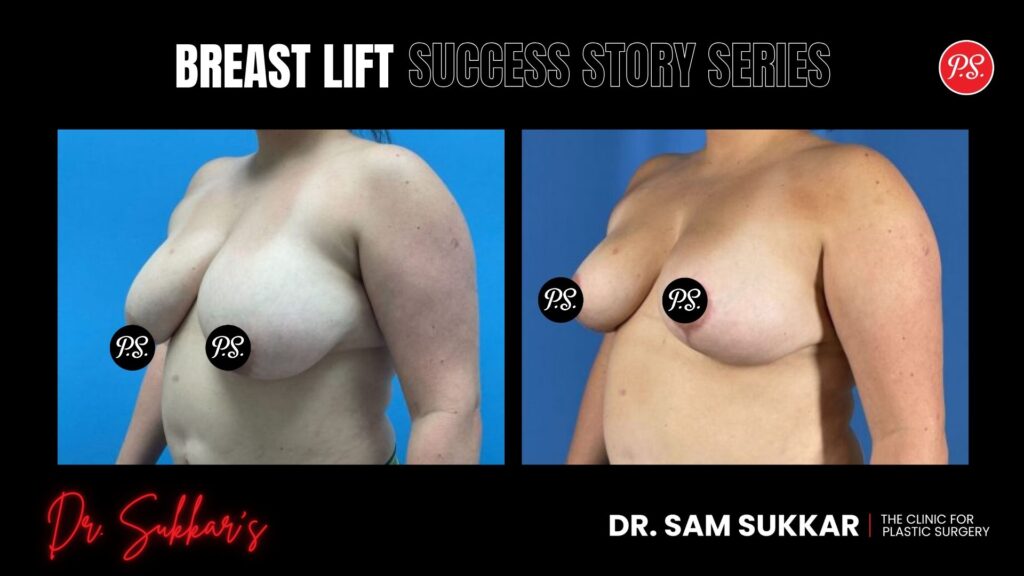

At 63, Rebecca* had reached a breaking point. Not with aging itself, she’d embraced every laugh line and gray hair with grace, but with the physical burden that had been quietly stealing her quality of life. The woman who once gardened for hours, played with grandchildren without hesitation, and moved through her days with ease now found herself exhausted by simple household tasks.

Her GG-cup breasts had become more than an aesthetic concern; they were affecting her mobility, causing chronic discomfort, and making her feel disconnected from the active life she’d always lived. When she finally walked into my Houston office, she wasn’t asking to turn back time. She was asking for her life back.

*The patient’s name was changed to protect their privacy. All medical details and photographic before and after results are from actual Patient Case #3386. Individual results may vary based on body type, surgical approach, and adherence to post-operative instructions.

Rebecca’s* Path to Breast Reduction and Lift

Living with the Physical and Emotional Weight

Rebecca* stood 5’5″ and carried GG-cup breasts that had become increasingly problematic over the years. What many don’t realize is that excessively large breasts aren’t just a cosmetic issue, they’re a medical one. Rebecca* experienced daily shoulder and neck pain, indentations from bra straps that bore the weight of her chest, and persistent skin irritation beneath her breasts. Simple activities like reaching overhead to change a light bulb, bending to load the dishwasher, or playing on the floor with her grandchildren left her winded and aching.

But the physical discomfort was only part of her story. Rebecca* described feeling “old” in a way that had nothing to do with her actual age. She avoided social situations where she’d have to stand for extended periods. Shopping for clothing had become an exercise in frustration and defeat. Breast lift surgery wasn’t about vanity for Rebecca*, it was about reclaiming the active, engaged life she deserved.

Addressing Her Hesitations

Rebecca* came to our consultation with understandable concerns. At 63, she wondered if she was “too old” for surgery. She worried about recovery time and whether the results would look natural for her age. She’d heard stories about breast lift scars and questioned whether the trade-off would be worth it.

I addressed each concern directly. Age alone doesn’t disqualify anyone from being a surgical candidate, overall health matters far more. Rebecca* was in excellent general health, making her an ideal candidate. As for scarring, I explained that while incisions are necessary for the dramatic lift and reduction she needed, strategic placement and my surgical technique would minimize their visibility. Most importantly, I assured her that my goal wasn’t to give her the breasts of a 20-year-old, but rather to create proportionate, lifted breasts that would look natural on her frame and allow her to move comfortably through her daily life.

Breast Lift at 63: How This Houston Patient Reclaimed Her Life - Breast Lift Success Story Series in Houston, Texas by Dr. Sam Sukkar, MD

Designing Rebecca’s* Breast Reduction and Lift Strategy

The Surgical Approach

Rebecca’s* transformation required a breast reduction combined with a mastopexy (breast lift). This wasn’t simply about making her breasts smaller or repositioning them higher on her chest, it was about creating a comprehensive solution that would address both her functional limitations and aesthetic goals.

1. Breast Reduction

  • Removed excess breast tissue to reduce volume from GG cup to full D cup
  • Eliminated the weight causing chronic shoulder, neck, and back discomfort
  • Reduced skin irritation and improved overall breast health

2. Mastopexy (Breast Lift)

  • Repositioned the nipple-areola complex to a more youthful position
  • Removed excess skin that had stretched over decades
  • Reshaped breast tissue to create a firmer, more lifted appearance

3. Tissue Reshaping and Contouring

  • Redistributed remaining breast tissue for optimal projection and symmetry
  • Created a natural breast shape appropriate for Rebecca’s* body proportions
  • Ensured results would age naturally and maintain their improved position

The combination of reduction and lift worked synergistically. By removing excess tissue, I reduced the gravitational pull that causes breasts to sag. By lifting and reshaping, I created a more youthful contour. The result would be breasts that not only looked better but functioned better, lighter, higher, and properly proportioned to Rebecca’s* 5’5″ frame.

Why This Combined Approach Made Sense

Over my 25+ years performing breast lift procedures in Houston, I’ve learned that cookie-cutter approaches don’t work. Some patients need only a lift to address sagging. Others need implants to restore lost volume. Rebecca* needed reduction because her primary concern was the burden of excessive size, combined with a lift to address the ptosis (drooping) that naturally accompanies large, heavy breasts.

Had I performed only a reduction without the lift component, her breasts would have been smaller but still positioned too low on her chest wall. Had I attempted only a lift without reduction, I wouldn’t have addressed the weight issue that was causing her daily discomfort. The integrated approach ensured we’d solve both problems simultaneously, giving Rebecca* one recovery period for comprehensive results.

This is why I spend considerable time in consultation understanding not just what a patient sees in the mirror, but how they feel in their body. Rebecca* wasn’t primarily concerned with how her breasts looked in clothing, she was concerned with how they affected her ability to live actively. That distinction guided every surgical decision I made. Understanding the difference between breast lift approaches allowed me to recommend exactly what Rebecca* needed, nothing more and nothing less.

What Recovery Looked Like for Rebecca*

The First Two Weeks: Honest Expectations

Rebecca* woke from surgery with surgical dressings, a supportive surgical bra, and small drainage tubes to prevent fluid accumulation. Those first 72 hours required rest and patience. She experienced tightness across her chest, manageable discomfort (controlled with prescribed pain medication), and the natural swelling that accompanies any surgical procedure.

Let me be direct: the early days after breast reduction and lift aren’t easy, but they’re manageable. Rebecca* felt tired, surgery is a metabolic stress on the body, and needed help with daily tasks. She couldn’t lift her arms overhead, drive, or lift anything heavier than a coffee cup. But she wasn’t in severe pain. Most patients describe the sensation as tightness and soreness rather than sharp pain.

Week 1-2: Early Recovery Progress

By the end of the first week, Rebecca’s* drainage tubes were removed (a relief for most patients). She transitioned to over-the-counter pain relievers and began short, slow walks around her home to promote circulation. Swelling peaked during this period, making it impossible to judge final results, but Rebecca* already noticed the dramatic difference in weight. Her shoulders felt lighter. She could stand upright without the forward-pulling sensation she’d lived with for years.

Critical Recovery Rules Rebecca Followed:*

  • Wore the surgical bra 24/7 (removed only for brief showers)
  • Avoided raising arms above shoulder height for two weeks
  • Slept elevated on her back to minimize swelling
  • No lifting, pushing, or pulling anything over 10 pounds
  • Kept incisions clean and dry to prevent infection

These restrictions weren’t suggestions, they were requirements for optimal healing. Rebecca* understood that following post-operative instructions directly impacted her final outcome, and she committed fully to the process. Proper adherence to breast lift recovery protocols significantly influences both healing time and long-term results.

Weeks 3-8: Returning to Normal Life

Rebecca* reached a milestone during week three: she could shower without assistance, dress herself comfortably, and perform light household tasks. The constant tightness had eased significantly. She returned for her follow-up appointment, where I cleared her to gradually resume more activities, including driving (once she could comfortably wear a seatbelt and make emergency movements without hesitation).

This is the phase where most patients start recognizing the transformation taking shape. Swelling had decreased enough that Rebecca* could see the improved breast contour. Her incisions were healing well, and the lifted position of her breasts was becoming apparent. She still wore her surgical bra during the day and avoided strenuous activities, but she felt like herself again, only better.

Weeks 5-8: Final Results Emerging

By two months post-surgery, Rebecca* had transitioned to regular supportive bras (properly fitted, which I always recommend after breast surgery). She’d gradually reintroduced exercise, starting with walking and eventually resuming her gardening, something she’d largely given up before surgery due to the physical strain.

The transformation was remarkable. From GG cup to full D cup represented not just a change in bra size but a complete shift in how Rebecca* experienced daily life. Her breasts sat higher on her chest, creating a more youthful silhouette. The weight that had pulled her shoulders forward for years was gone. She moved differently, standing taller, moving more freely, engaging more confidently with the world around her.

Rebecca’s* Transformation: Three Months Post-Surgery

The objective measurements told part of Rebecca’s* story: a reduction from GG cup to full D cup, repositioned nipples, removed excess skin, and eliminated chronic shoulder grooving from bra straps. But those numbers only captured the technical success of the procedure.

The real transformation became evident in how Rebecca* described her experience. She called it “extremely satisfying” and “very easy”, words that might surprise those unfamiliar with how life-changing proper breast proportions can be. She wasn’t exaggerating. For someone who’d spent years limited by the physical burden of excessively large breasts, the relief was profound.

Rebecca* returned to activities she’d abandoned or avoided. She played actively with her grandchildren without becoming quickly fatigued. Rebecca* tackled household projects with renewed energy. She shopped for clothing and actually enjoyed the experience. Perhaps most tellingly, she became so enthusiastic about her results that she couldn’t wait to refer friends and family to our practice, a testament that speaks louder than any marketing material ever could.

Breast Lift at 63: How This Houston Patient Reclaimed Her Life - Breast Lift Success Story Series in Houston, TX by Dr. Sam Sukkar, MD

The Factors Behind Rebecca’s* Exceptional Outcome

Several elements contributed to Rebecca’s* outstanding result:

Realistic expectations aligned with surgical possibilities. Rebecca* didn’t expect to look 25 again. She wanted functional improvement and age-appropriate aesthetic enhancement. That clarity allowed me to design a surgical plan that met her actual needs.

Excellent surgical candidacy. Despite being 63, Rebecca* was in strong overall health, a more important factor than chronological age. Good candidates for breast lift surgery are defined by health status, not age alone.

Perfect procedural match for her concerns. The combination of reduction and lift addressed both the weight issue and the positioning problem. A lift alone wouldn’t have solved her functional limitations. A reduction alone wouldn’t have corrected the sagging. The integrated approach was essential.

Comprehensive follow-through during recovery. Rebecca* followed every post-operative instruction meticulously. She attended all follow-up appointments, wore her surgical garments as directed, and avoided restricted activities during the critical healing phases. Patient compliance directly impacts surgical outcomes.

Age-appropriate surgical technique. I approached Rebecca’s* surgery differently than I would a 35-year-old’s breast lift. Tissue quality, skin elasticity, and healing capacity change with age. Respecting those differences and adjusting technique accordingly ensures results that look natural and heal predictably.

Questions About Breast Reduction and Lift for Mature Patients

Is 63 too old for breast reduction and lift surgery?

Absolutely not. Age alone doesn’t determine surgical candidacy, overall health does. I’ve successfully performed breast reduction and lift procedures on patients well into their 60s and 70s. What matters is cardiovascular health, ability to heal, and realistic expectations. Rebecca’s* excellent health made her an ideal candidate despite her age. If you’re in good general health and cleared by your primary care physician, age shouldn’t be a barrier to achieving the breast proportions and comfort you deserve.

How long do breast lift results last, especially for older patients?

Breast lift results are long-lasting, though they’re not immune to aging and gravity. For mature patients like Rebecca*, the key advantage is that their bodies have largely completed the changes associated with aging, pregnancy, and significant weight fluctuations. This stability actually works in their favor. With proper support (well-fitted bras), healthy lifestyle maintenance, and stable weight, results can last 10-15 years or more. The relief from chronic discomfort caused by excessively large breasts is typically permanent, as the removed tissue doesn’t return. Many patients find that even if some natural settling occurs over time, they remain far more comfortable than they were before surgery.

Can breast reduction and lift be combined with other procedures?

Yes, and many patients choose to address multiple concerns in a single surgical session. However, for mature patients, I often recommend a focused approach rather than extensive combination procedures. Rebecca’s* surgery concentrated specifically on her breasts because that was her primary concern and the source of her functional limitations. This allowed for a shorter anesthesia time, more straightforward recovery, and less metabolic stress on her body. That said, some patients do successfully combine breast surgery with procedures like breast lift with augmentation when restoration of volume is also needed. The decision depends entirely on individual health status, goals, and surgical plan.

Ready to Write Your Own Breast Lift Success Story?

Rebecca* walked into my Houston office carrying the weight of years, literally. She walked out three months later, grateful for what she called a “lift in life.”

Your situation might be different. Maybe you’re dealing with sagging after breastfeeding, frustrated by asymmetry, or like Rebecca*, struggling with the physical burden of overly large breasts. Perhaps you’ve been told you’re “too old” for cosmetic surgery, or you’re uncertain whether the results would justify the recovery.

But here’s what I know after 25+ years and more than 20,000 procedures: You deserve to feel confident and comfortable in your own body. Age is no barrier when health permits, and the right surgical approach can restore not just appearance but quality of life. If changes in your breasts are affecting your daily activities, self-confidence, or physical comfort, transformation is possible.

Schedule Your Personalized Consultation here, or call us today at (281) 940-1535 and discover what’s possible for your unique body and goals in Houston!

Your Premier Destination for Plastic Surgery in Houston, Texas (TX)

Are you located in one of these Houston Metro Area cities?

Houston, The Woodlands, Sugar Land, Katy, Pearland, Pasadena, League City, Baytown, Conroe, Cypress, Spring, Kingwood, Humble, Missouri City, Friendswood, Bellaire, Clear Lake, Tomball, Galveston, Richmond, Rosenberg, Stafford, La Porte, Deer Park, Seabrook, Webster, Alvin, and Channelview.

Board-Certified Plastic Surgeon Dr. Sam Sukkar, MD, FACS, and The Clinic for Plastic Surgery Team are here to help you achieve refined, natural-looking results.

Offering expert cosmetic enhancements in:

  • Breast Augmentation, Breast Lifts, and Breast Reduction
  • Tummy Tucks, Mommy Makeovers, and Liposuction
  • Facelifts, Neck Lifts, and Rhinoplasty
  • Body Contouring and Skin Tightening Procedures
  • Non-Surgical Aesthetic Treatments

Visit our modern 18,000+ sq.ft. luxurious plastic surgery center and med spa in Houston, Texas, where expertise meets artistry. Our highly skilled and compassionate team ensures a seamless experience, from consultation to recovery.

For patients outside of the Houston area or those with a busy schedule, Schedule a Virtual Consultation.

Schedule your personalized consultation today at DrSukkar.com or call (281) 940-1535.

About the Author – Meet Dr. Sam Sukkar, MD

Dr. Sam Sukkar, MD, FACS is a highly respected Board-Certified Plastic Surgeon in Houston, Texas, known for his expertise in advanced cosmetic and reconstructive procedures. As the founder of The Clinic for Plastic Surgery, Dr. Sukkar has set a new standard for excellence, performing over 20,000 procedures with a focus on delivering natural, refined results.

Dr. Sukkar earned his Doctor of Medicine (M.D.) degree from Louisiana State University School of Medicine in 1992 after graduating summa cum laude with a Bachelor of Science in Microbiology. He then completed an intensive General Surgery Residency at the University of Texas Hermann Hospital before being selected for a highly competitive Plastic Surgery Fellowship at Northwestern University in Chicago, one of the most prestigious training programs in the country.

With more than 20 years of experience, Dr. Sukkar is a Diplomate of the American Board of Plastic Surgery and a Fellow of the American College of Surgeons (FACS). He is also an active member of the American Society of Plastic Surgeons (ASPS) and the Houston Society of Plastic Surgery (HSPS). His dedication to innovation and continuing education has solidified his reputation as a leading expert in aesthetic surgery, specializing in breast surgery, body contouring, facial procedures, and non-invasive treatments.

Dr. Sukkar’s expertise has been recognized by Houston Magazine, naming him one of Houston’s “Top Docs for Women,” and he has been featured among RealSelf’s America’s Top Doctors. Committed to his patients, he prioritizes personalized care, ensuring every individual feels informed, comfortable, and confident in their aesthetic journey.

Contact Dr. Sukkar today to schedule a consultation, visit DrSukkar.com to learn more, or call us directly at (281) 940-1535.

Breast Augmentation at 35: Houston Patient’s Natural Results

Breast Augmentation Success Story Series by Dr. Sam Sukkar, MD | Case Study #06


This is part of our series featuring real patient transformations at The Clinic for Plastic Surgery. Each case study provides an in-depth look at actual procedures, recovery experiences, and results from Houston patients who’ve undergone breast augmentation with Dr. Sam M. Sukkar.


When Rebecca* entered the consultation room, she carried something invisible but heavy: years of self-consciousness about her figure. At 35, this busy professional had always felt disproportionate, her petite frame made her naturally small chest appear even more diminutive in fitted clothing. She wasn’t looking for dramatic transformation. She wanted balance. Proportion. The confidence to stop second-guessing every outfit choice.

What she found was exactly that, and the surgical precision to make it last.

*The patient’s name was changed to protect their privacy. All medical details and photographic before and after results are from actual Patient Case #06. Individual results may vary based on body type, surgical approach, and adherence to post-operative instructions.

Rebecca’s* Path to Breast Augmentation

The Proportion Problem

Standing 5’4″ and 116 pounds, Rebecca* had what many would call an enviable figure, except she didn’t feel that way. Her A-cup chest created an imbalance she’d noticed since her early twenties. Fitted blazers gaped. Swimsuits required constant adjustments. The gym became an exercise in strategic layering rather than confident movement.

She’d considered breast augmentation surgery for years but hesitated. Would implants look natural on her petite frame? Could a surgeon understand her goal of enhancement without exaggeration?

When Rebecca* finally scheduled her consultation, she came prepared with photos of results she admired, subtle, proportionate enhancements that looked like they belonged. She wanted to fill out her clothing naturally, not announce her surgery to everyone who looked at her.

Addressing Pre-Surgery Hesitations

Rebecca* voiced concerns I hear frequently from women considering their first breast augmentation:

Would the implants feel foreign? She worried about sensation changes and whether moderate-profile silicone implants would feel natural during everyday activities. I explained that modern cohesive gel implants are designed to mimic natural breast tissue, and that placement under the muscle provides additional soft tissue coverage for a more authentic feel.

How would she hide recovery from her demanding career? As someone who traveled frequently for work, Rebecca* needed realistic timelines. I was straightforward: you’ll need two weeks minimum before returning to desk work, and four to six weeks before lifting anything substantial. Strategic scheduling would be essential.

Could we achieve proportion without looking “done”? This was her primary concern. I reassured her that for petite frames, moderate-profile implants in the 300-350cc range typically provide noticeable enhancement while maintaining natural contours, especially when placed under the pectoralis muscle.

Breast Augmentation at 35: Houston Patient’s Natural Results - Breast Augmentation Success Story Series in Houston, Texas by Dr. Sam Sukkar, MD

The Surgical Approach: Tailored Breast Augmentation for Rebecca*

What the Procedure Involved

Rebecca’s* case required meticulous planning to achieve her proportionate goals. Here’s the specific approach we used:

1. Breast Augmentation (Augmentation Mammoplasty) with Silicone Implants

  • Moderate-profile, 325cc smooth round silicone gel breast implants
  • Submuscular (dual-plane) placement for enhanced soft tissue coverage
  • Inframammary fold incision for precise pocket creation and minimal visible scarring

The moderate profile was deliberate, it provides forward projection appropriate for Rebecca’s* chest wall width without creating an overly round or artificial appearance. Submuscular placement positions the implant beneath the pectoralis major muscle, which offers several advantages for petite patients: additional tissue coverage over the implant, reduced visibility of implant edges, and lower rates of capsular contracture.

The inframammary fold incision allows direct access to create the implant pocket with exceptional precision, ensuring symmetrical positioning and optimal lower pole fill. This approach also preserves nipple sensation better than areolar or transaxillary techniques.

Why This Strategy Works

After performing thousands of breast augmentation procedures over 25+ years, I’ve learned that successful outcomes for petite frames depend on three critical factors: implant size selection, profile choice, and placement technique.

Size selection must account for chest wall dimensions, not just desired cup size. Rebecca’s* 325cc volume was calculated based on her base width measurements, large enough to create the C-cup she desired, but not so large as to stretch her skin envelope beyond comfortable limits. Going too large on a petite frame creates unnatural upper pole fullness and increases long-term complications.

Moderate profile rather than high profile was essential. High-profile implants project farther forward with less width, creating a more pronounced, round appearance. Rebecca* wanted natural proportion, moderate profile distributes volume more evenly across the breast footprint, mimicking how natural breast tissue sits on the chest wall.

Submuscular placement provides critical advantages for women with minimal existing breast tissue. The pectoralis muscle acts as a natural barrier between the implant and skin, softening visible edges and creating gradual, natural-looking slopes. For active women like Rebecca*, this placement also offers better implant stability during upper body movement.

The inframammary approach I selected gives me the most direct control over pocket dissection, critical for preventing asymmetry or malposition. The incision hides in the natural breast fold and typically heals to a thin, barely visible line.

What Recovery Looked Like for Rebecca*

The First Two Weeks: Managing Early Healing

Rebecca* described the first 72 hours as uncomfortable but manageable. The submuscular placement creates significant muscle tightness, patients often say it feels like an intense chest workout that won’t release. Pain medication controlled discomfort, but movement required deliberate care.

Swelling was pronounced. Her breasts sat high on her chest wall, a normal consequence of muscle tension and post-surgical inflammation. I reminded her this “high and tight” appearance would resolve as muscles relaxed and implants settled into their pockets.

She slept elevated at 45 degrees, avoided reaching overhead, and wore her surgical support bra continuously. These early days require patience and strict adherence to movement restrictions.

Weeks 1-2: Early Mobility Returns

By day five, Rebecca* noticed improvement. The acute muscle soreness diminished to a dull ache. She could move around her home with less restriction, though lifting anything heavier than a coffee mug remained off-limits.

Critical recovery rules for this phase included: No lifting over five pounds. No reaching overhead. No side-sleeping. I also emphasized gentle arm movements to prevent shoulder stiffness, many patients unconsciously guard their chest and develop secondary tension in surrounding muscles.

Rebecca* returned to desk work at the two-week mark, still tired by mid-afternoon but functional. She continued wearing supportive sports bras and avoided underwire, which could irritate healing incision sites.

Weeks 3-8: Transformation Takes Shape

Rebecca* described week three as the turning point when she started feeling like herself again. Energy returned. The muscle tightness released significantly. Most importantly, she could see her implants beginning to settle, the unnatural high position gradually softened as tissues relaxed.

Light cardiovascular exercise resumed at three weeks, with strict avoidance of chest and upper body work. Walking, gentle cycling, and lower body movements were safe. High-impact activities and upper body resistance training remained prohibited until the six-week mark.

Months 2-3: Final Results Emerge

By eight weeks post-operation, Rebecca* had clearance for full activity resumption. Her breast implants had settled into their final position, creating the natural slope and projection she’d envisioned. The “drop and fluff” process, where implants descend into the lower breast pole and soft tissue expands around them, was complete.

Her measurements told part of the story: she went from a 32A to a 34C. But what mattered more to Rebecca* was how she felt in her clothing. Blazers fit properly. Dresses required no adjustments. She could wear whatever she wanted without second-guessing proportions.

Rebecca’s* Transformation: Three Months Post-Surgery

Rebecca* achieved the proportionate, natural enhancement she’d pursued. Her 325cc moderate-profile silicone implants created balanced upper and lower pole fullness without the obvious roundness that signals “augmented.” At three months post-op, her results had fully matured, soft, mobile, and completely integrated with her natural tissue.

Breast Augmentation at 35: Houston Patient’s Natural Results - Breast Augmentation Success Story Series in Houston, TX by Dr. Sam Sukkar, MD

What Makes Natural Results Possible

Several factors contributed to Rebecca’s* exceptional outcome:

Precise size calculation based on measurements, not desires alone. Many patients want to jump multiple cup sizes, but successful augmentation respects anatomical limitations. Rebecca’s* chest dimensions allowed 325cc comfortably, going larger would have created visible rippling or implant malposition over time.

Conservative profile selection for petite frames. Moderate profile distributes volume appropriately for naturally proportioned breasts. High-profile or extra-high-profile implants create excessive forward projection that looks unnatural on smaller chest walls.

Submuscular placement for adequate soft tissue coverage. Women with minimal natural breast tissue need the additional camouflage that muscle placement provides. This approach prevents visible implant edges and maintains natural movement patterns.

Strategic incision placement preserving nipple sensation. The inframammary approach avoids disrupting sensitive tissue around the areola or navigating the complex anatomy of the axilla. Rebecca* retained full sensation, a priority she’d expressed during consultation.

Patient commitment to recovery protocols. Rebecca* followed every restriction precisely, allowing optimal healing without complications. Patients who rush recovery often compromise their final results through premature activity or inadequate support.

Common Questions About Breast Augmentation for Petite Frames

Will moderate-profile implants provide enough projection for someone with a small chest?

Absolutely. For petite patients like Rebecca* moderate-profile implants in the 300-350cc range typically provide excellent projection while maintaining natural proportions. The key is matching implant dimensions to your chest wall measurements, not simply choosing a target cup size. During consultation, I use dimensional analysis to determine which implant profile will create your desired look without overwhelming your frame. Various implant types serve different aesthetic goals, and moderate profile consistently delivers natural-looking results for smaller body types.

How long before submuscular breast implants feel completely normal?

Most patients report that muscle tightness resolves substantially by weeks 3-4, but complete adaptation takes 2-3 months. Rebecca* noticed the “foreign” feeling diminish progressively, first during rest, then during light activity, and finally during vigorous movement. By three months, she couldn’t distinguish her augmented breasts from how natural tissue might feel. The submuscular adjustment period is longer than subglandular placement, but the long-term benefits, better coverage, reduced complications, more natural appearance, make the temporary discomfort worthwhile.

Can you return to exercise and normal activities after breast augmentation?

Yes, with appropriate timing. I cleared Rebecca* for light cardio at three weeks, but restricted upper body and high-impact work until six weeks post-op. Premature chest exercises or heavy lifting can displace healing implants or cause bleeding. The recovery timeline I provide isn’t arbitrary, it’s designed to protect your investment and ensure optimal settling. By eight weeks, Rebecca* had full clearance and returned to her complete fitness routine without limitations.

Ready to Write Your Own Breast Augmentation Success Story?

Rebecca* came to my Houston office carrying years of proportion concerns and hesitation. Eight weeks later, she had the balanced, natural figure she’d always wanted, and the confidence that comes with feeling comfortable in your own body.Your story might be different. Maybe you’re concerned about implant selection, wondering about recovery demands, or trying to understand which approach will look most natural on your frame. But the common thread is this: You deserve to feel confident and comfortable in your own body. Your body deserves the same dedication you give to fitness and health. If these concerns are affecting your quality of life, transformation is possible.

Schedule Your Personalized Consultation here, or call us today at (281) 940-1535 and discover what’s possible for your unique body and goals in Houston!

Your Premier Destination for Plastic Surgery in Houston, Texas (TX)

Are you located in one of these Houston Metro Area cities?

Houston, The Woodlands, Sugar Land, Katy, Pearland, Pasadena, League City, Baytown, Conroe, Cypress, Spring, Kingwood, Humble, Missouri City, Friendswood, Bellaire, Clear Lake, Tomball, Galveston, Richmond, Rosenberg, Stafford, La Porte, Deer Park, Seabrook, Webster, Alvin, and Channelview.

Board-Certified Plastic Surgeon Dr. Sam Sukkar, MD, FACS, and The Clinic for Plastic Surgery Team are here to help you achieve refined, natural-looking results.

Offering expert cosmetic enhancements in:

  • Breast Augmentation, Breast Lifts, and Breast Reduction
  • Tummy Tucks, Mommy Makeovers, and Liposuction
  • Facelifts, Neck Lifts, and Rhinoplasty
  • Body Contouring and Skin Tightening Procedures
  • Non-Surgical Aesthetic Treatments

Visit our modern 18,000+ sq.ft. luxurious plastic surgery center and med spa in Houston, Texas, where expertise meets artistry. Our highly skilled and compassionate team ensures a seamless experience, from consultation to recovery.

For patients outside of the Houston area or those with a busy schedule, Schedule a Virtual Consultation.

Schedule your personalized consultation today at DrSukkar.com or call (281) 940-1535.

About the Author – Meet Dr. Sam Sukkar, MD

Dr. Sam Sukkar, MD, FACS is a highly respected Board-Certified Plastic Surgeon in Houston, Texas, known for his expertise in advanced cosmetic and reconstructive procedures. As the founder of The Clinic for Plastic Surgery, Dr. Sukkar has set a new standard for excellence, performing over 20,000 procedures with a focus on delivering natural, refined results.

Dr. Sukkar earned his Doctor of Medicine (M.D.) degree from Louisiana State University School of Medicine in 1992 after graduating summa cum laude with a Bachelor of Science in Microbiology. He then completed an intensive General Surgery Residency at the University of Texas Hermann Hospital before being selected for a highly competitive Plastic Surgery Fellowship at Northwestern University in Chicago, one of the most prestigious training programs in the country.

With more than 20 years of experience, Dr. Sukkar is a Diplomate of the American Board of Plastic Surgery and a Fellow of the American College of Surgeons (FACS). He is also an active member of the American Society of Plastic Surgeons (ASPS) and the Houston Society of Plastic Surgery (HSPS). His dedication to innovation and continuing education has solidified his reputation as a leading expert in aesthetic surgery, specializing in breast surgery, body contouring, facial procedures, and non-invasive treatments.

Dr. Sukkar’s expertise has been recognized by Houston Magazine, naming him one of Houston’s “Top Docs for Women,” and he has been featured among RealSelf’s America’s Top Doctors. Committed to his patients, he prioritizes personalized care, ensuring every individual feels informed, comfortable, and confident in their aesthetic journey.

Contact Dr. Sukkar today to schedule a consultation, visit DrSukkar.com to learn more, or call us directly at (281) 940-1535.

Breast Lift Success: 37-Year-Old’s Asymmetry Solution

Breast Lift Success Story Series by Dr. Sam Sukkar, MD | Case Study #3372


This is part of our series featuring real patient transformations at The Clinic for Plastic Surgery. Each case study provides an in-depth look at actual procedures, recovery experiences, and results from Houston patients who’ve undergone breast lift surgery with Dr. Sam M. Sukkar.
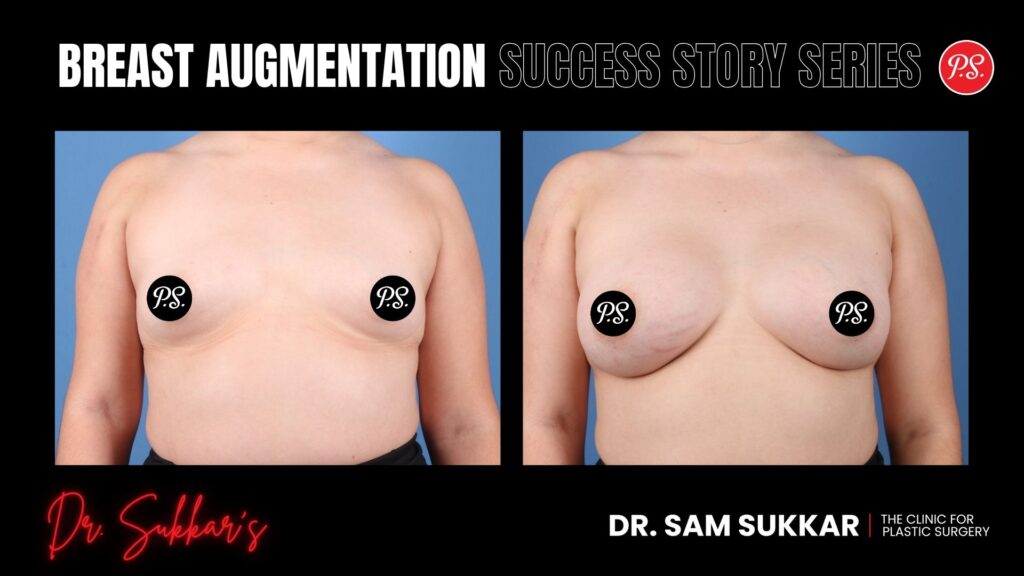

Three months. That’s all it took for Abigail* to look at her reflection and recognize herself again, not the tired version, but the confident woman she’d been before gravity and asymmetry took their toll.

At 37, Abigail had noticed what many women eventually face: her breasts had changed. Not in size, she’d always been a D cup, but in shape and position. One breast sat noticeably lower than the other. The ptosis (drooping) had become impossible to hide, even with the most supportive bras. While researching breast lift options in Houston, she kept getting distracted by stunning tummy tuck transformations. After weeks of internal debate, she made a decision that would address both concerns in a single surgery.

The results? She’s thriving.

*The patient’s name was changed to protect their privacy. All medical details and photographic before and after results are from actual Patient Case #3372. Individual results may vary based on body type, surgical approach, and adherence to post-operative instructions.

What Brought Abigail* to The Clinic for Plastic Surgery

The Concerns That Led to Her Decision

Abigail’s* primary frustration wasn’t the size of her breasts, it was the asymmetry. One breast had descended significantly more than the other, creating a visible imbalance that affected her clothing choices and self-image. The ptosis made her feel older than her years, and she found herself avoiding form-fitting tops and certain styles altogether.

But as she explored breast lift options, she spent hours reviewing breast lift before and after galleries on our website. That’s when something unexpected happened: she became captivated by the tummy tuck results. Though her abdominal concerns had taken a backseat to her breast issues, seeing the dramatic improvements in other patients made her reconsider. Why not address both areas at once?

During our consultation, she expressed a clear vision: restore symmetry and lift to her breasts while achieving a firmer, more contoured midsection. She wasn’t looking to change her cup size, she wanted her D cups back where they belonged.

Pre-Surgery Considerations

Like many patients, Abigail had questions that needed answers before committing to surgery:

Recovery logistics: How would combining procedures impact her downtime? Could she realistically manage recovery from both surgeries simultaneously?

Scarring: She understood scarring was inevitable but wanted to know what to expect and how to minimize visibility long-term.

Results longevity: Would her breasts maintain their lifted position? How permanent were these changes?

I assured her that combining procedures is common and, in many cases, more efficient than staging them separately. While recovery requires commitment, many patients find that addressing multiple concerns in one surgery, with a single recovery period, is worth the initial investment of time and energy. As for scarring, my techniques prioritize minimal, well-placed incisions that fade significantly over time. Abigail’s* age and good skin elasticity were also favorable factors for optimal healing.

Breast Lift Success: 37-Year-Old's Asymmetry Solution - Breast Lift Success Story Series in Houston, Texas by Dr. Sam Sukkar, MD

Designing Abigail’s* Surgical Approach

The Dual-Procedure Strategy

After thorough evaluation, I developed a customized surgical plan targeting both her breast and abdominal concerns:

1. Breast Lift (Mastopexy)

  • Anchor-pattern incision technique to address moderate to severe ptosis
  • Repositioning of the nipple-areola complex to a higher, more youthful position
  • Removal of excess skin to create a firmer, more lifted breast contour
  • Reshaping of breast tissue to restore symmetry between both breasts

2. Tummy Tuck (Abdominoplasty)

  • Full abdominoplasty with muscle repair to tighten separated abdominal muscles
  • Removal of excess skin and stubborn fat from the lower abdomen
  • Recontouring of the waistline for a smoother, more defined silhouette
  • Strategic incision placement along the bikini line for discreet scarring

This combination is particularly effective because it addresses two of the most common post-pregnancy and aging-related concerns in a single operation. By performing breast lift surgery alongside a tummy tuck, we maximized her transformation while minimizing overall recovery time compared to staging procedures months apart.

The Clinical Reasoning Behind the Plan

Abigail’s* case required balancing aesthetic goals with practical considerations. Her breast asymmetry demanded precise tissue repositioning and skin removal, not just on one side, but with careful calibration to achieve symmetry between both breasts. The anchor-pattern mastopexy technique allowed me the versatility needed to lift, reshape, and reposition her breasts while maintaining natural proportions.

The decision to add a tummy tuck came from Abigail herself, but it was clinically sound. Many patients don’t realize that addressing multiple body zones simultaneously can produce more harmonious results than piecemeal procedures. In over 25 years of practice, I’ve found that comprehensive transformations often yield higher satisfaction because the entire silhouette changes together, creating balanced, proportionate outcomes.

For Abigail, maintaining her D cup size was essential, she didn’t want smaller or larger breasts, just lifted, symmetrical ones. This clarity made surgical planning straightforward. We weren’t adding volume with implants or reducing size with tissue removal beyond what was necessary for the lift. The focus was pure positional correction and breast lift without breast implants.

Navigating Recovery: Abigail’s* Post-Operative Experience

The First Two Weeks: Adjustment and Patience

Abigail described the first 72 hours as the most challenging. She experienced tightness across her abdomen from the tummy tuck and sensitivity around her breast incisions. Movement required deliberate effort, she walked slightly hunched to avoid pulling on her abdominal sutures and needed help with overhead reaching due to breast lift restrictions.

Pain management was critical during this window. She followed her prescribed medication schedule closely and used ice packs to reduce swelling. Sleep was only comfortable in a reclined position, and she relied on support pillows to maintain proper positioning.

Week 1-2: Gradual Improvement

By the end of the first week, Abigail noticed tangible progress. The initial swelling began subsiding, and she could move more independently. She still wore her surgical compression garment for the tummy tuck and a supportive surgical bra for her breasts, both essential for optimal healing.

Critical recovery protocols she followed:

  • No lifting anything over 10 pounds to protect abdominal muscle repair
  • Keeping incisions clean and dry to prevent infection
  • Avoiding overhead arm movements to minimize tension on breast lift incisions
  • Walking regularly (short, gentle walks) to promote circulation and reduce blood clot risk
  • Staying hydrated and eating protein-rich foods to support tissue healing

By week two, she returned for her first follow-up appointment. Incisions were healing beautifully, and early signs of her new contours were becoming visible beneath the residual swelling.

Weeks 3-8: Watching the Transformation Unfold

This phase marked a turning point. Abigail transitioned out of prescription pain medication and into over-the-counter options as needed. She could dress herself without assistance, drive short distances, and resume light daily activities. The tightness in her abdomen softened, and the lifted position of her breasts became more apparent.

She still avoided strenuous exercise and heavy lifting, but her energy levels improved dramatically. Many patients describe this period as “seeing the light at the end of the tunnel,” and Abigail was no exception.

Weeks 5-8: Results Taking Shape

At the two-month mark, Abigail’s* transformation was undeniable. Swelling had diminished significantly, revealing the true contours of her breast lift and tummy tuck. Her breasts sat higher and more symmetrically, with her nipples repositioned to a natural, youthful level. Her abdomen was flat and firm, with a defined waistline.

She gradually reintroduced exercise, starting with walking and light cardio, then progressing to core-strengthening activities under my guidance. Understanding breast lift recovery time and realistic expectations helped her stay patient during the healing process.

Three-Month Results: Symmetry Restored, Confidence Renewed

At her three-month follow-up, Abigail’s* results spoke for themselves:

Breast Outcomes:

  • Symmetrical breast positioning with both breasts sitting at matching heights
  • Nipple-areola complexes repositioned to a youthful, natural level
  • Maintained D cup volume with improved shape and firmness
  • Minimal scarring with incision lines fading as expected

Abdominal Outcomes:

  • Flat, contoured midsection with tightened abdominal wall
  • Smooth waistline free of excess skin
  • Well-healed tummy tuck scar along the bikini line
  • Restored core strength and improved posture

Beyond the physical changes, Abigail reported a profound shift in how she felt. She no longer avoided certain clothing styles or worried about visible asymmetry. Her confidence had returned, not because she looked like someone else, but because she looked like herself again.

Breast Lift Success: 37-Year-Old's Asymmetry Solution - Breast Lift Success Story Series in Houston, TX by Dr. Sam Sukkar, MD

What Made This Outcome Exceptional

Several factors contributed to Abigail’s* outstanding results:

  1. Patient-driven decision-making: Abigail’s* choice to combine procedures came from researching our tummy tuck before and after galleries and recognizing an opportunity to address multiple concerns at once.
  2. Age and skin quality: At 37, Abigail’s* skin had good elasticity, which supported excellent healing and scar maturation.
  3. Precise surgical technique: The anchor-pattern mastopexy allowed for significant lifting and reshaping while maintaining natural breast proportions. The full abdominoplasty addressed both skin laxity and muscle separation.
  4. Strict adherence to post-operative instructions: Abigail followed recovery protocols meticulously, which directly impacted her healing quality and scar appearance.
  5. Realistic expectations and patience: She understood that final results take time to emerge and trusted the process, which reduced anxiety and supported optimal healing.

Common Questions About Breast Lift and Tummy Tuck Combinations

Can you safely combine a breast lift with a tummy tuck?

Yes, combining these procedures is common and safe when performed by an experienced surgeon. Many patients prefer addressing both areas in a single surgery to consolidate recovery time. The key is careful surgical planning, appropriate anesthesia management, and realistic patient expectations about the recovery period. I’ve performed thousands of combination procedures throughout my career, and when patients are good candidates, the results can be transformative.

How long do breast lift results last without implants?

Breast lift results are long-lasting, but not entirely permanent. Factors like aging, gravity, weight fluctuations, and future pregnancies can affect breast position over time. However, most patients enjoy their lifted, symmetrical results for many years. Maintaining a stable weight, wearing supportive bras, and following healthy lifestyle habits can help preserve your results. For patients like Abigail who maintained their original cup size, the lifted position typically holds up beautifully because we’re working with their natural tissue rather than adding implants.

What should I expect from breast lift scarring?

Breast lift scars are inevitable with mastopexy, but their appearance improves significantly over time. The anchor-pattern technique creates incisions around the areola, vertically down to the breast crease, and horizontally along the crease. Initially, scars are red and visible, but within 6-12 months, they typically fade to thin, light lines. Abigail’s* scars at three months were healing nicely, and I expect them to continue fading over the coming months. Proper scar care, including silicone sheets, sun protection, and following post-op instructions, makes a substantial difference.

Ready to Write Your Own Breast Lift Success Story?

Abigail walked into my Houston office concerned about asymmetry and drooping that had been affecting her confidence for years. She walked out three months later with symmetrical, lifted breasts and a flat, contoured abdomen, results she couldn’t stop smiling about.

Your concerns might be different. Maybe you’re focused solely on addressing breast ptosis, wondering whether breast lift vs implants is the right choice for you, or considering whether a breast lift with augmentation would better meet your goals.

The common thread is simple: You deserve to feel confident and comfortable in your own body. Your body deserves the same dedication you give to fitness and health. If asymmetry, ptosis, or body contour concerns are affecting your quality of life, transformation is possible.

Schedule Your Personalized Consultation here, or call us today at (281) 940-1535 and discover what’s possible for your unique body and goals in Houston!

Your Premier Destination for Plastic Surgery in Houston, Texas (TX)

Are you located in one of these Houston Metro Area cities?

Houston, The Woodlands, Sugar Land, Katy, Pearland, Pasadena, League City, Baytown, Conroe, Cypress, Spring, Kingwood, Humble, Missouri City, Friendswood, Bellaire, Clear Lake, Tomball, Galveston, Richmond, Rosenberg, Stafford, La Porte, Deer Park, Seabrook, Webster, Alvin, and Channelview.

Board-Certified Plastic Surgeon Dr. Sam Sukkar, MD, FACS, and The Clinic for Plastic Surgery Team are here to help you achieve refined, natural-looking results.

Offering expert cosmetic enhancements in:

  • Breast Augmentation, Breast Lifts, and Breast Reduction
  • Tummy Tucks, Mommy Makeovers, and Liposuction
  • Facelifts, Neck Lifts, and Rhinoplasty
  • Body Contouring and Skin Tightening Procedures
  • Non-Surgical Aesthetic Treatments

Visit our modern 18,000+ sq.ft. luxurious plastic surgery center and med spa in Houston, Texas, where expertise meets artistry. Our highly skilled and compassionate team ensures a seamless experience, from consultation to recovery.

For patients outside of the Houston area or those with a busy schedule, Schedule a Virtual Consultation.

Schedule your personalized consultation today at DrSukkar.com or call (281) 940-1535.

About the Author – Meet Dr. Sam Sukkar, MD

Dr. Sam Sukkar, MD, FACS is a highly respected Board-Certified Plastic Surgeon in Houston, Texas, known for his expertise in advanced cosmetic and reconstructive procedures. As the founder of The Clinic for Plastic Surgery, Dr. Sukkar has set a new standard for excellence, performing over 20,000 procedures with a focus on delivering natural, refined results.

Dr. Sukkar earned his Doctor of Medicine (M.D.) degree from Louisiana State University School of Medicine in 1992 after graduating summa cum laude with a Bachelor of Science in Microbiology. He then completed an intensive General Surgery Residency at the University of Texas Hermann Hospital before being selected for a highly competitive Plastic Surgery Fellowship at Northwestern University in Chicago, one of the most prestigious training programs in the country.

With more than 20 years of experience, Dr. Sukkar is a Diplomate of the American Board of Plastic Surgery and a Fellow of the American College of Surgeons (FACS). He is also an active member of the American Society of Plastic Surgeons (ASPS) and the Houston Society of Plastic Surgery (HSPS). His dedication to innovation and continuing education has solidified his reputation as a leading expert in aesthetic surgery, specializing in breast surgery, body contouring, facial procedures, and non-invasive treatments.

Dr. Sukkar’s expertise has been recognized by Houston Magazine, naming him one of Houston’s “Top Docs for Women,” and he has been featured among RealSelf’s America’s Top Doctors. Committed to his patients, he prioritizes personalized care, ensuring every individual feels informed, comfortable, and confident in their aesthetic journey.

Contact Dr. Sukkar today to schedule a consultation, visit DrSukkar.com to learn more, or call us directly at (281) 940-1535.